Dressing Baby for Cold Nights Without Overheating
A cold snap doesn't mean more blankets. How to layer a baby for cold nights: fabric weights, what goes under a sleep sack, and the four things to never add.
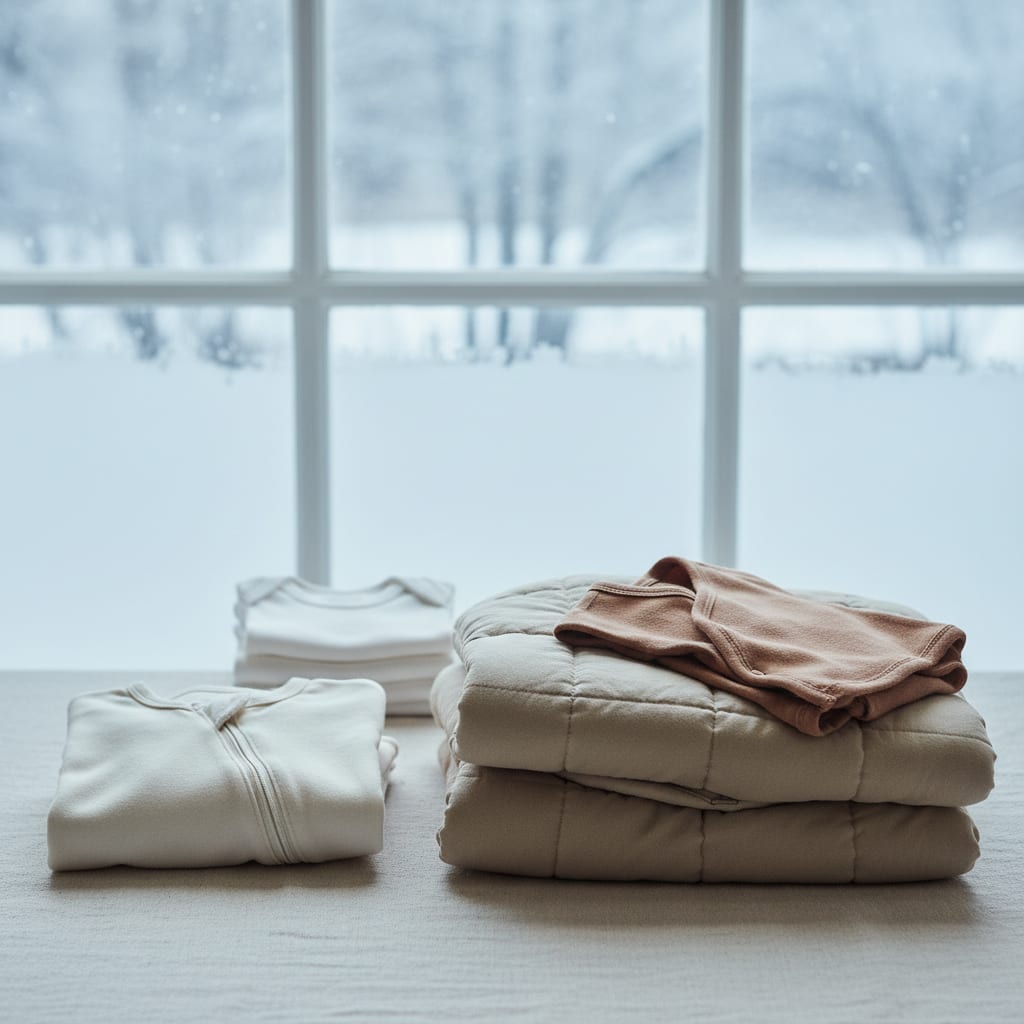
Short answer: when the temperature drops, you change the fabric weight, not the number of loose things in the crib. One base layer plus a warmer sleep sack, chosen against the room’s actual overnight temperature, is the whole system. A common rule of thumb is to dress a baby in roughly one more layer than you’d be comfortable sleeping in yourself. Loose blankets aren’t recommended in the sleep space for the first year, hats indoors for sleep aren’t either, and weighted sacks and swaddles are not recommended by the American Academy of Pediatrics — so the cold snap gets solved with better fabric, not more stuff.
I find it helps to think about this exactly the way I think about my own closet in November. You don’t handle a cold night by throwing three more things on the bed. You handle it by wearing wool instead of cotton.
A cold snap is a fabric problem
Every layering decision in a nursery comes down to two variables: thermal weight and breathability. A baby who’s too warm and damp is in a worse position than one who’s a touch cool, which is why the fiber matters more than the layer count.
- Cotton — breathable, washes forever, but it holds moisture once it’s damp and stops insulating. Perfect as a base layer, mediocre as your only line of defense in a genuinely cold room.
- Merino wool — the one that behaves differently. It regulates across a much wider temperature band and stays warm when slightly damp, which is why merino sleep sacks aren’t usually sold with a single TOG number.
- Bamboo viscose — silky and very breathable, cooler than it feels. Lovely, but a bamboo base layer is a summer choice, not a January one.
- Fleece and polyester — warm and cheap, and the least breathable of the group. Fine as a sack fill in a cold room, worth avoiding as a base layer under a warm sack.
That list is the whole strategy. Swap the fiber, keep the layer count the same.
The layering formula
Base layer + sleep sack. That’s it.
The base layer is chosen by room temperature: a short-sleeve bodysuit in a warm room, a long-sleeve bodysuit around 68–72°F (20–22°C), and footed pajamas plus a bodysuit underneath when the room genuinely drops. Footed pajamas are the workhorse of the cold months because feet and hands run cooler than the core anyway, and a footed style solves that without anything loose. A plain zip-front sleeper like the Burt’s Bees Baby zip-front footie is the version I’d buy in multiples — the zip matters at 3 a.m. more than any other feature on the garment.
The sack is chosen by TOG. Roughly: 0.5 TOG in a warm room, 1.0–1.5 in the common 68–75°F band, 2.5 for cool rooms around 61–68°F (16–20°C), and 3.5 below that — with the chart on the bag you actually own overriding all of it, because brands set their bands a degree or two apart. The full breakdown, including which weights are worth owning, is in my sleep sack TOG guide.
| Room overnight | Base layer | Sack |
|---|---|---|
| 72–75°F (22–24°C) | Short-sleeve bodysuit | 0.5–1.0 TOG |
| 68–72°F (20–22°C) | Long-sleeve bodysuit | 1.0–1.5 TOG |
| 64–68°F (18–20°C) | Bodysuit + footed pajamas | 2.0–2.5 TOG |
| Below 64°F (18°C) | Bodysuit + footed pajamas | 2.5–3.5 TOG |
Two layers, two decisions. Adding a third layer is almost always the wrong move — it’s the point at which you stop being able to tell which layer is causing the problem.
Four things not to add
Loose blankets. Not under 12 months, no matter how cold it gets. The sleep sack exists precisely because the blanket needed to become a garment.
A hat indoors. Babies lose heat through the head, which is part of how they regulate temperature; covering it during sleep is not recommended, and a hat that shifts is a hazard in its own right. Hats are for outside.
A weighted sack or weighted swaddle. The AAP does not recommend weighted sleepwear for infants. Warmth is not what those products are for, and they’re not the answer to a cold room.
Anything with a hood, cord, tie or loose ribbon. Fine in a stroller, wrong in a crib.
If your baby is still swaddled, the same logic applies with less room to maneuver — you’re choosing the swaddle’s fabric weight and the single layer beneath it, and Betteroo’s rundown of swaddle options for newborns covers which fabrics behave how.
How to check you got it right
Feel the chest or the back of the neck. Not the hands, not the feet — those run cool on babies normally and have ended more nights of parental sleep than any real problem. What you want is warm and dry.
Too warm looks like damp hair at the neckline, a flushed face, sweating, or fast breathing. The fix is to remove the base layer, not to change the whole sack; the sack is matched to the room, and the room hasn’t changed. Erring very slightly cool is the safer direction of the two.
The 4 a.m. problem
Here’s the thing about a cold snap that nobody warns you about: the room isn’t one temperature all night. Most heating systems run down overnight and fire again in the early morning, and the coldest stretch of the night is usually somewhere between 4 and 6 a.m. — which is exactly when sleep is lightest and a baby is likeliest to surface.
So a sudden run of 5 a.m. wake-ups during the first cold week of the season is often just thermal. Before you rebuild the entire schedule, check the temperature at crib height at dawn rather than at bedtime, and dress for the low end of the range rather than the average. If it keeps happening after the layers are right, it’s stopped being a fabric problem, and Betteroo’s guide to early-morning wake-ups is where I’d go next.

Where the cold actually comes from
Cold snaps expose the room, not the pajamas. Single-glazed windows radiate cold from a foot away, exterior walls run below the room average, and floor-level drafts are worse in older buildings than a thermometer at chest height suggests.
Boring fixes that work: move the crib off the exterior wall and away from the window if the room allows it, close the curtains before dusk rather than at bedtime, and leave a thermometer at crib height for a few nights so you’re dressing for a measurement instead of a guess. For the small-space version — including where a crib can go when there is no spare wall — I wrote it up in baby sleep in a small apartment. And if the cold nights have quietly turned into you being the heat source, how to stop contact naps is the gentler way back out.
FAQ
What should a baby wear to sleep in a cold room?
A bodysuit plus footed pajamas under a 2.5 TOG sleep sack for rooms around 61–68°F (16–20°C), and a 3.5 TOG sack below that. Choose by the room’s overnight temperature rather than the outdoor forecast, and check the chart on the sack you own.
Can I put a blanket over my baby in a cold snap?
Not in the first year. Loose bedding isn’t recommended in the sleep space, and a cold snap doesn’t change that. Use a warmer sleep sack or a heavier base layer instead — that’s the substitution the sack was designed for.
Should a baby wear a hat to bed when it’s cold?
No. Head covering during sleep isn’t recommended indoors, both because babies regulate temperature through the head and because a hat can shift out of place. Hats are for outdoors; indoors, add warmth through the sack instead.
How do I know if my baby is cold at night?
Feel the chest or the back of the neck, which should be warm and dry. Cool hands and feet are normal and are not a sign of a cold baby. Persistent restlessness in the coldest hours before dawn, with a genuinely cool chest, points to a room that’s dropping further overnight than you think.
Are weighted sleep sacks good for cold weather?
No — the American Academy of Pediatrics does not recommend weighted sleepwear for infants, and weight isn’t what makes a sack warm anyway. Warmth comes from TOG and fiber, so a higher-TOG or merino sack is the right answer to a cold room.
Keep Reading
The New-Mom Gift Guide: What She Actually Wants in 2026
Gifts new moms actually use — no novelty mugs. The Betteroo sleep app that saved us, the robe that isn't hideous, and more picks grouped by budget.
Spanx Air Essentials Dupes: 7 Cheaper Sets I'd Rebuy
Seven Spanx Air Essentials dupes tested through months of real washes: which butter-soft sets keep their drape, which ones pill, and when to buy real.
Sleep Sack TOG Ratings: Dress for the Room, Not the Season
A plain-English sleep sack TOG guide: what the numbers mean, which TOG suits your room's real temperature, what to layer underneath, and the two-bag capsule.