Sleep Sack TOG Ratings: Dress for the Room, Not the Season
A plain-English sleep sack TOG guide: what the numbers mean, which TOG suits your room's real temperature, what to layer underneath, and the two-bag capsule.
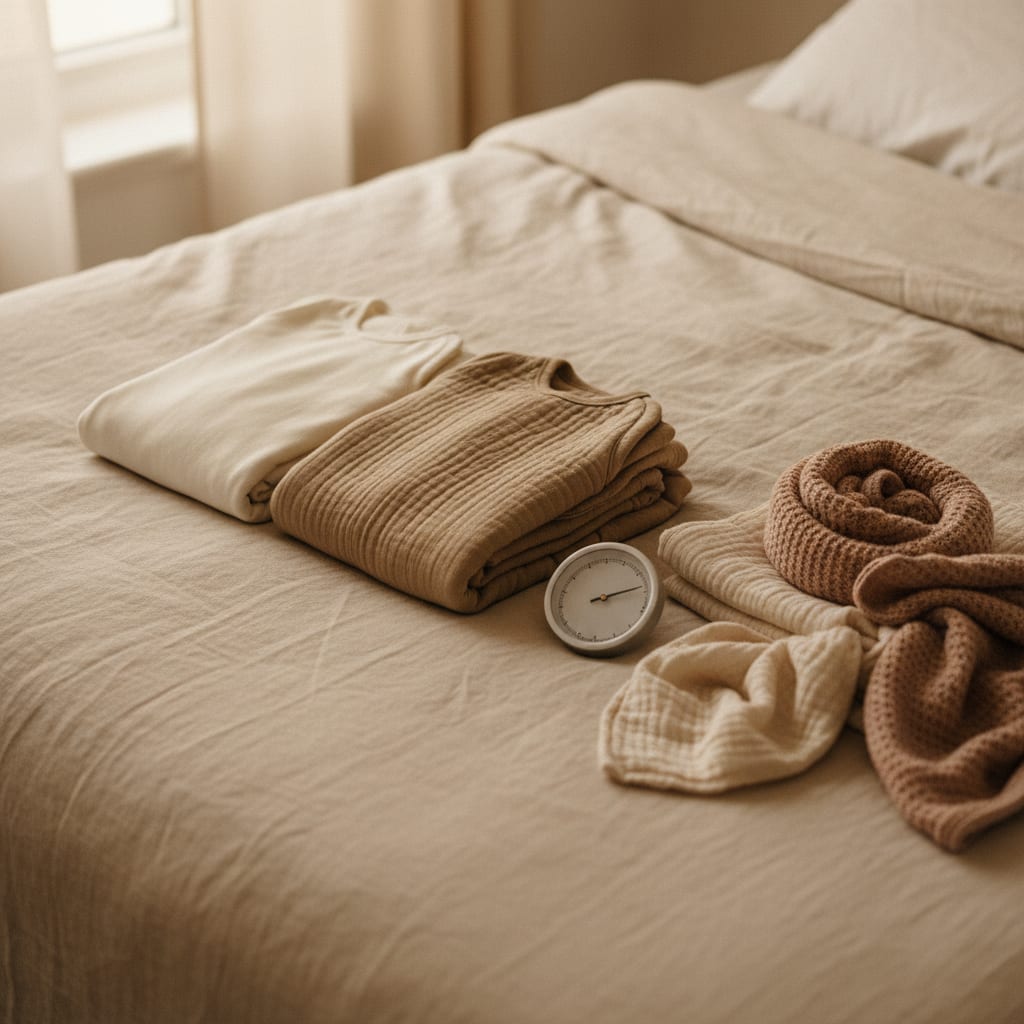
Short answer: TOG is a warmth rating, and you choose it by the temperature of the room your baby actually sleeps in overnight — not by the month on the calendar. Roughly: 0.5 TOG for warm rooms around 75°F (24°C) and up, 1.0–1.5 TOG for the common 68–75°F (20–24°C) range, 2.5 TOG for cool rooms around 61–68°F (16–20°C), and 3.5 TOG below that. Brand charts differ by a degree or two, so follow the chart printed on the bag you own.
I think about this the way I think about my own closet, because it is the same problem. Nobody sensible dresses for “it’s October.” You dress for the actual conditions — a 74°F upstairs bedroom in October is a linen-tee situation regardless of what the leaves are doing outside.
What TOG actually measures
TOG stands for Thermal Overall Grade: a standard measure of thermal resistance, i.e. how much warmth a fabric traps. Higher number, warmer garment. It’s the same idea as duvet tog ratings in the bedding aisle, and it’s the closest thing baby sleepwear has to a fabric-weight label.
Two useful things follow from that. First, TOG describes the sack, not the outfit — what your baby wears underneath is a separate decision, and it’s the one most people get wrong. Second, TOG is not a safety certification. A high number isn’t “better.” In a warm room it’s actively the wrong choice, because overheating is the risk you’re managing here, not cold.
The chart
| Room temperature | TOG | What goes underneath |
|---|---|---|
| 75°F+ (24°C+) | 0.2–0.5 | Diaper only, or a short-sleeve bodysuit |
| 72–75°F (22–24°C) | 0.5–1.0 | Short-sleeve bodysuit |
| 68–72°F (20–22°C) | 1.0–1.5 | Long-sleeve bodysuit or lightweight footed pajamas |
| 64–68°F (18–20°C) | 2.0–2.5 | Long-sleeve bodysuit plus footed pajamas |
| Below 64°F (18°C) | 2.5–3.5 | Warm base layer plus footed pajamas |
Treat this as the consensus shape rather than gospel — manufacturers publish slightly different bands, and a merino bag behaves differently from a quilted cotton one at the same number. Most guidance puts the target room itself somewhere around 68–72°F (20–22°C), which is why 1.0 and 1.5 TOG bags are the ones that sell out.
Measure the room, not the forecast
This is the part people skip. The temperature that matters is in the room, at the height of the crib, at 3 a.m. — not the thermostat downstairs and not the daytime reading.
Things that make the overnight number diverge wildly from what you’d guess:
- Upstairs rooms swing hardest. Heat rises; a nursery over a warm kitchen can sit several degrees above the rest of the house all night.
- Air conditioning cycles. The room can be 74°F at bedtime and 67°F by dawn, which is exactly the drift that produces a 5 a.m. wake-up.
- Radiators and vents have a schedule. If your heating fires at 5:30 a.m., the last stretch of the night is the warmest, not the coldest.
- Blackout coverings hold heat. The blackout panel that fixed your early wakings also insulates the window.
A cheap room thermometer left in place for a few nights settles all of it. Betteroo’s guide to the right room temperature for baby sleep walks through the recommended range and how to hit it in a room you can’t fully control — worth reading before you buy a single sack, because the room decides the number.
How to tell if you got it wrong
Check the chest or the back of the neck. Hands and feet run cooler than the core in babies and are a famously unreliable signal — cool hands do not mean a cold baby. What you’re after is warm and dry. Damp hair at the neckline, a flushed face, sweating or rapid breathing all mean too warm, and the fix is to remove a layer underneath before you change the whole sack.
Erring slightly cool is the safer direction. Overheating is the failure mode that safe-sleep guidance warns about, and it’s also why sleep sacks exist in the first place — loose blankets aren’t recommended in the sleep space for the first year, so the blanket became a garment.
The two-bag capsule
Here is where my actual expertise transfers. You do not need six sleep sacks in six weights. You need the same thing a wardrobe needs: a small number of pieces that cover the real range, in enough duplicate that laundry never strands you.
Two weights, two of each. A light bag for summer and warm rooms, a warm bag for winter, and a spare of whichever one is in season — because the reflux night happens, and it happens at 2 a.m.
For the warm end, the HALO SleepSack cotton wearable blanket is the sensible default: 0.5 TOG, plain cotton, sized rather than one-size, and cheap enough to own two without resentment. For a household that would rather buy once, a merino option like the Woolino 4 Season sleep sack covers a much wider temperature range on the fiber’s own regulating behavior — note that the standard merino bags aren’t sold by a single TOG number for that reason, so you’re trusting the wool rather than a chart.
Fit Notes: Sizing is where sleep sacks go wrong. The body should be roomy — legs need to move — but the neck opening and armholes must be snug enough that the bag can’t ride up over the face. Buying a size up “to last longer” is the one place the usual thrift logic doesn’t apply. Check the neck and arms every time you size up, and retire any bag your baby has started to swim in at the shoulders.
Toddlers are a different problem
Somewhere after the first birthday the question stops being warmth and starts being containment: the climbing, the unzipping, the kicking off of anything with a leg hole. Betteroo’s rundown of sleep sacks that work for toddlers covers the walkable, two-way-zip versions and when to move on from a bag entirely.
If the room, the layers and the bag are all right and the nights are still a mess, the variable isn’t the fabric — it’s the schedule or the wake windows. Betteroo builds a plan around your own baby’s ages and patterns; their sleep plan quiz is the fastest way to find out which one you’re actually dealing with.
For the rest of the environment — light, sound, and where the crib should go when there isn’t a spare room — I wrote up the whole setup in baby sleep in a small apartment. And if the thing keeping you up is being the mattress rather than the temperature, how to stop contact naps is the gentler exit route.
FAQ
What TOG sleep sack should I use at 70 degrees?
At 70°F (21°C), a 1.0–1.5 TOG sack over a long-sleeve bodysuit or lightweight footed pajamas is the standard pairing. Check the chart on your specific bag, since brands set their bands slightly differently.
Is a 2.5 TOG sleep sack too warm for summer?
In most homes, yes. 2.5 TOG is built for rooms around 61–68°F (16–20°C). If your summer nursery sits in the seventies, a 2.5 TOG bag will overheat your baby even with nothing underneath.
What should a baby wear under a sleep sack?
One layer, chosen by room temperature: a diaper only or short-sleeve bodysuit in a warm room, a long-sleeve bodysuit around 68–72°F, and footed pajamas plus a base layer in a genuinely cold room. Adjust the layer underneath before you change the sack.
How do I know if my baby is too hot in a sleep sack?
Feel the chest or the back of the neck — not the hands or feet, which run cool normally. Warm and dry is right; damp, flushed, sweating or breathing fast means too warm. Remove one layer underneath and re-check in twenty minutes.
How many sleep sacks do I actually need?
Two weights and a spare of the in-season one — so three or four total. A light bag for warm rooms, a warm bag for cold ones, and enough duplication that a middle-of-the-night change doesn’t leave you without a clean option.
Keep Reading
The New-Mom Gift Guide: What She Actually Wants in 2026
Gifts new moms actually use — no novelty mugs. The Betteroo sleep app that saved us, the robe that isn't hideous, and more picks grouped by budget.
Vuori Dupes That Actually Feel Like Vuori
Vuori dupes worth buying: the Amazon joggers, leggings and hoodie closest to the real thing, the Vuori pieces that can't be duped, and how to judge a listing.
The 2026 Gift Guide for Teen Girls (Vetted by an Actual Teen)
Gifts for teen girls, grouped by budget and vetted line-by-line by my fourteen-year-old. What actually lands, what got vetoed, and the receipt rule.