Color-Changing Night Light Waking Your Toddler? Here's Why
Color-changing night lights are sold on the feature that wakes children. What light does after lights-out, why a shifting hue pulls a child up, and what to use.
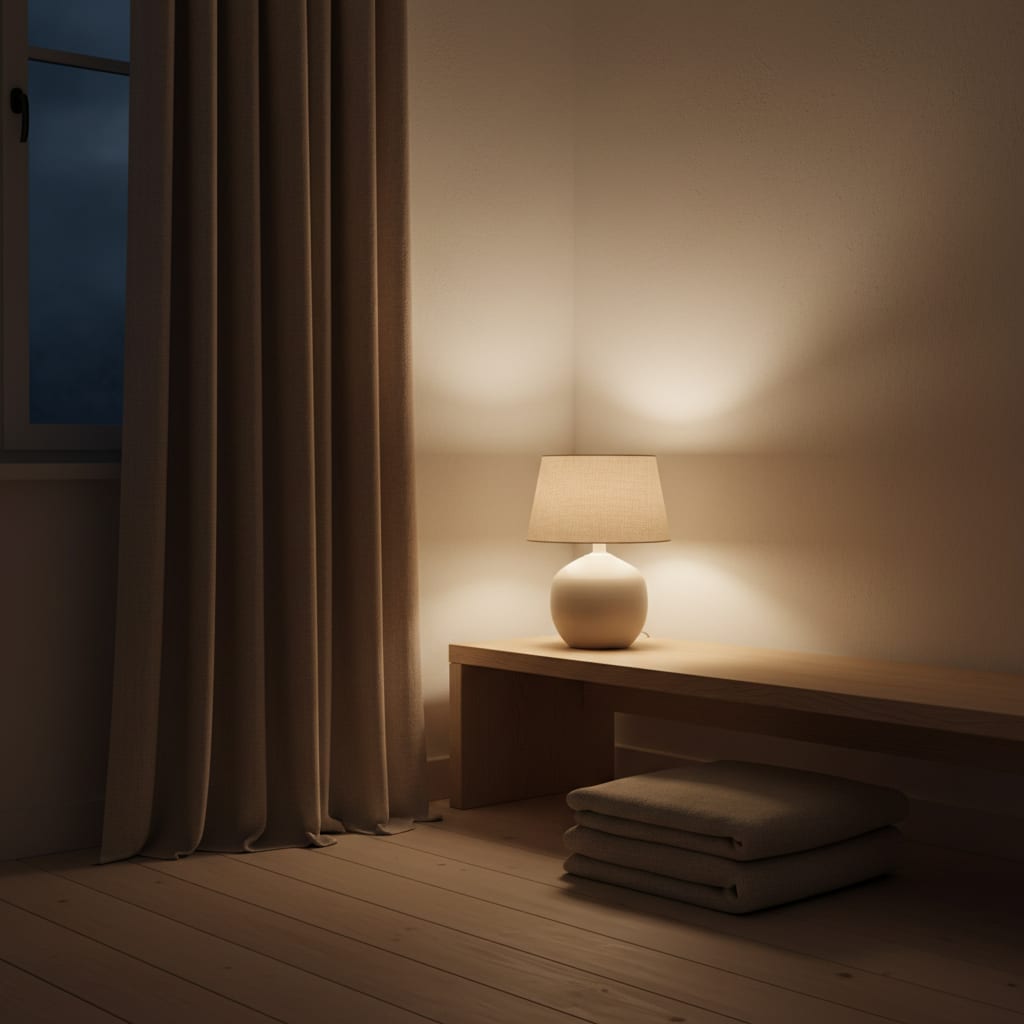
Short answer: a night light that changes color is a light that keeps announcing itself, and the announcement is what wakes your child. Two things go wrong at once. A shifting hue is a change in a room you spent months making boringly consistent, and any cycle passing through blue, white or green runs an alerting color in a room you darkened on purpose. What a bedroom needs at 2 a.m. is one color, warm, dim and never changing — precisely the light a color-changing model is designed not to give you.
What light is doing in a room you thought was dark
Children are not small adults on this, and the size of the gap is the part that surprises people. Researchers at the University of Colorado Boulder note that because children’s eyes have larger pupils and more transparent lenses than adults, light streams into them more freely — with one study finding the transmission of blue light through a nine-year-old’s eye 1.2 times higher than an adult’s.
The result is a child who reacts to light levels you would call darkness. In that team’s work on preschoolers, exposure “measured at 5 to 40 lux, which is much dimmer than typical room light” dropped melatonin by an average of 78%, with suppression running from 70% to 99% — and, tellingly, “little-to-no relationship between how bright the light was and how much the key sleep hormone fell.” Dimming a bad light is not the same as fixing it.
The recovery is slow, too. In an earlier bright-light study from the same group, average melatonin suppression was 87.6%, and levels stayed significantly lower 20 and 50 minutes after the light went off. A brief glow that resolves itself is not a brief problem.
Why a shifting hue wakes a child who slept through a steady one
A steady night light becomes furniture. Your child’s visual system stops reporting it within minutes, the same way you stop hearing your own fridge. Nothing about a constant is worth waking for.
A change is the opposite. Vision is built to flag what alters, and a light fading from amber to teal over ninety seconds is, for all ninety of them, an event. A cycling model never lets the room settle into a state at all.
Then there is the discrepancy problem, which is the one that produces 2 a.m. calls rather than trouble at bedtime. Children surface briefly between sleep cycles all night — that is normal and usually invisible. A child who surfaces into a room that is green when they went to sleep in an orange one has something to resolve before they can go back down. It is the same mechanism that makes a repainted room stop working overnight; I wrote about that in why a freshly redecorated nursery breaks a bedtime.
None of this makes them defective. As an evening toy they are lovely. They are just not sleep equipment, and the box rarely says so.
Color temperature is the number, not the shade
If the light does hold one color, which color matters more than the brightness dial does.
A 2025 study of evening light in early childhood put preschoolers under two lights at the same measured brightness — 20 lux photopic — differing only in color temperature. Melatonin suppression was 56.3% under the 5000 K light against 23.9% under the 2700 K one: same brightness, more than double the effect, purely from spectrum.
Harvard Health reaches the practical version of the same conclusion: “Use dim red lights for night lights. Red light is less likely to shift circadian rhythm and suppress melatonin”, noting that in one study blue light suppressed melatonin for about twice as long as green did.
So on a color wheel the blue, white, teal and lilac settings are the actively bad ones and the sunset-orange end is the least disruptive. The catch: you cannot judge color temperature by eye in a dark room — everything looks warm once your eyes have adapted. Buy a light that only does amber rather than trusting a preset labelled “warm.”
What to put in the room instead
Change the bulb, keep the lamp. This is the one that suits a room you actually like. Any small ceramic or glass lamp you own becomes a night light with a fixed-amber bulb in it — Neporal’s 1800 K amber A19 is a standard E26 screw fit, so it goes into a bedside lamp or a hallway sconce with no new object entering the room. No plastic mushroom on the nightstand, and nothing on a cycle.
Buy one purpose-built amber lamp. If you want something soft-edged and child-proof that lives on the floor, the SomniLight dimmable amber nursery lamp is a single-color unit with a dimmer rather than a palette, which is the specification that matters.
If you need a morning cue, make it a scheduled event, not a mode. The honest exception: a once-a-morning change is useful precisely because it is meaningful, which is the opposite of a cycle running all night. An ok-to-wake clock like the LittleHippo Mella holds one color all night and switches at a time you set. Read Betteroo on how ok-to-wake clocks are meant to be used first: the wrong wake time makes early mornings worse.
Placement does the rest. Put the light low, below mattress level, turned so it washes a wall or the floor. A light whose source your child cannot see from lying down is doing everything a night light needs to do.

Light Notes: fixing this in one evening
- Pick one color and never move off it. Amber or sunset-orange. Set it once, then put the remote in a drawer where a four-year-old will not find it.
- Turn the light away from the bed. Facing a wall, low down, source out of the sightline.
- Dim it further than feels necessary. Enough to find a door, not enough to read by.
- Deal with the window in the same evening. A night light is pointless if a streetlight is doing more work than it is — the full method is in blocking light at a bedroom window.
- Give it four nights. The first two after any change to a bedroom are not data.
What is not worth doing
Removing the light entirely because it “shouldn’t be needed.” A child who is genuinely frightened of the dark sleeps worse without one, and the small amber source is not the thing costing you the night. The cycling is.
Buying a second color-changing light with more presets. More modes is more change, not more control.
Leaving a hall light on instead. Usually brighter, cooler and whiter, with a door-shaped edge — and it goes off when you go to bed, which is a change of its own at the hour you are least equipped to handle it.
If you are also the one lying awake after the 2 a.m. call, that triage is separate: why you can’t fall back asleep after a night waking.
FAQ
What color night light is best for a toddler?
Amber, orange or dim red, held at one setting. Color temperature does real work at identical brightness: preschoolers showed 56.3% melatonin suppression under a 5000 K light against 23.9% under a 2700 K one at the same 20 lux. Avoid blue, white, teal and green.
Are color-changing night lights bad for sleep?
They are bad as night lights. The cycle is continuous change in a space that works by staying the same, and most palettes spend part of the loop in short-wavelength light.
My child slept fine with it for months. Why now?
A light that was always marginal starts costing you nights the moment anything else shifts — a nap dropped, a growth spurt, a house that gets dark earlier. On the last of those, see why bedtime slides when it gets dark at four.
How dim should a night light be?
Dimmer than you think. In the Colorado work, 5 to 40 lux still dropped melatonin by an average of 78%, and brightness barely predicted the drop. Aim for the least light that lets an adult cross the room safely.
What if my child wakes screaming rather than just waking?
No lighting change will touch that. Inconsolable, glassy-eyed waking an hour or two after bedtime looks nothing like an ordinary night waking — Betteroo’s guide to night terrors in toddlers sets out how to tell them apart.
Keep Reading

The New-Mom Gift Guide: What She Actually Wants in 2026
Gifts new moms actually use — no novelty mugs. The Betteroo sleep app that saved us, the robe that isn't hideous, and more picks grouped by budget.
Holiday Party Outfits: 8 Formulas for Every Kind of Party
Holiday party outfits for every invite, from the office party to the classroom party and Christmas dinner: eight copy-paste formulas and the one-shine rule.

Abercrombie Curve Love Jeans Review: Honest Fit Notes
An honest Abercrombie Curve Love jeans review from a mom of two: how the fit actually works, sizing quirks, wash-test results, and who should skip them.