How to Block a Streetlight From a Bedroom Window
A streetlight outside the window keeps a room lit all night. Here is how to black it out properly without the room looking like a hotel conference suite.
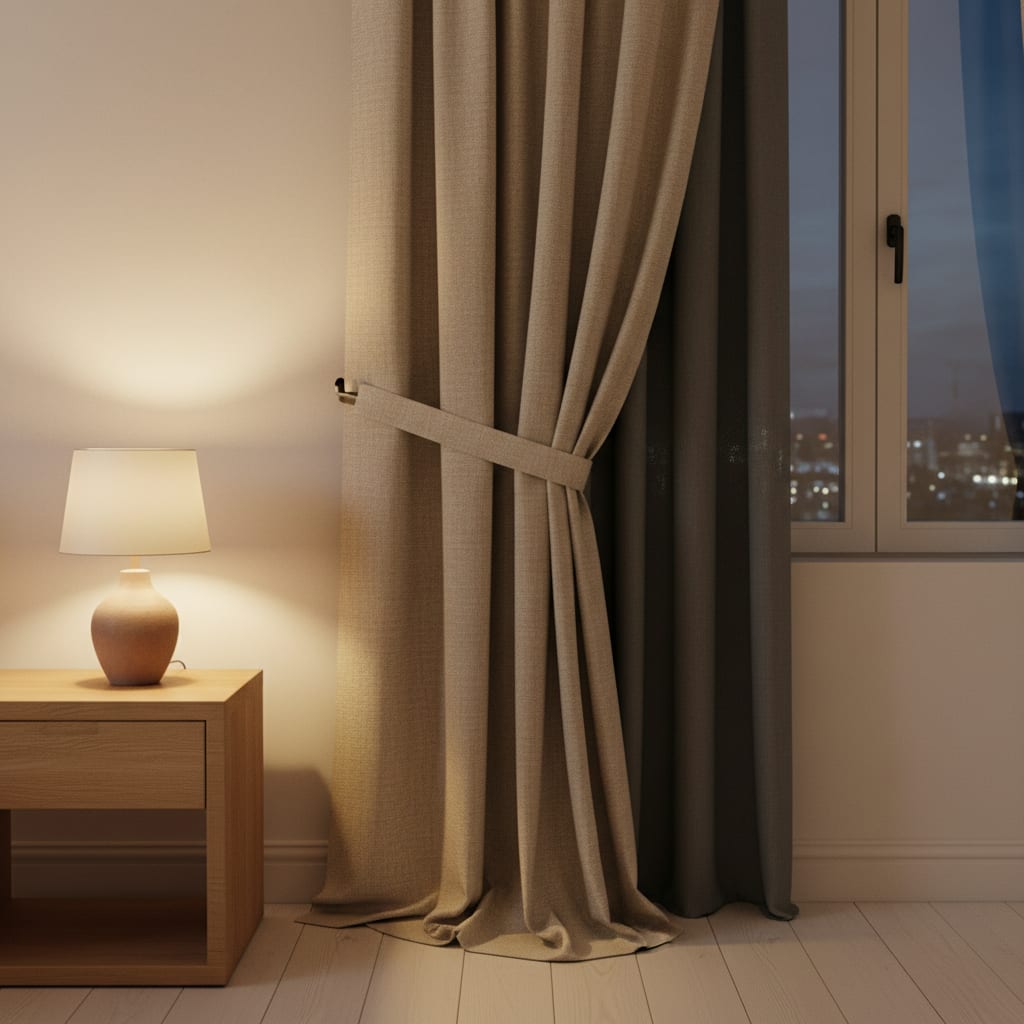
Short answer: hang a blackout liner behind the curtain you already like, and seal the edges rather than the middle. Almost all the light from a streetlight comes around a curtain — down the sides, over the rod, under the hem — not through the fabric. Fix the gaps and you can keep a soft linen curtain in a cream bedroom and still get a genuinely dark room. You never have to choose between a room that sleeps well and a room you like being in.
Why a streetlight is a different problem from daylight
Daylight has an off switch, so a curtain that is only mostly effective is fine for most of the year.
A streetlight is on for eleven hours a night, every night, at the same brightness, aimed roughly at your window. Anything less than proper blackout means the room never fully darkens — and the newer white LED lamps that replaced the old orange sodium ones are brighter, cooler and far more noticeable through a thin curtain.
That constancy is why a streetlight room is worth treating as one weekend’s engineering problem rather than as something you get used to — and the fix, once done, is permanent.
The light is coming in around the curtain, not through it
This is the single most useful thing to know, and it is why people buy expensive blackout curtains and stay disappointed.
The sides. A rod hung at the exact width of the window leaves a vertical strip of light down each edge — usually the biggest leak in the room.
The top. With a standard rod, light travels over the fabric and washes down the ceiling, which is exactly where a person lying down is looking.
The hem and the middle join. A curtain finishing an inch above the floor leaves a glowing line along the baseboard, and two panels meeting edge to edge with no overlap leave a slot down the center.
Fix those four and an ordinary lined curtain performs better than a premium blackout panel hung badly. Betteroo’s rundown of what actually blocks light at a window covers the blind-versus-curtain version of the same decision.
Four ways to do it, ranked by how they look
1. A blackout liner behind the curtains you own
The best answer for almost everyone. A separate panel hangs on the same rod behind your existing curtain, and nobody ever sees it. A set like the NICETOWN blackout curtain liners comes with hooks so the liner attaches to the curtain you already like, which means the room’s colour scheme is untouched.
Why it wins: the face fabric stays whatever you chose and the working layer is invisible. It also comes off for washing and moves house with you.
2. Blackout-lined curtains in a fabric that does not announce itself
If your current curtains were never right anyway, buy properly lined ones in a fabric with texture. A natural blackout linen-look curtain reads as a normal heavy curtain from inside the room; the black lining is sewn behind it and only visible from the street.
Fit Notes: buy the length, not the drop you think you need. Curtains that finish on the floor look intentional; curtains finishing at the sill look like a rental.
3. A blackout roller blind inside the recess, curtains over the top
The tidiest technical solution. A roller inside the recess handles the top and middle; the curtains over it handle the sides and the styling.
The catch: a recess-mounted roller always leaves a small side gap, because the fabric has to be narrower than the frame. Fine once curtains cover it, unacceptable on its own.
4. The temporary panel
Suction-cup travel blackout panels work and look like exactly what they are. Correct for a vacation rental, a grandparent’s spare room or the first fortnight in a new house; not a permanent answer for a room anyone spends time awake in.
Fit Notes: what makes blackout look like blackout
Five details separate a dark bedroom from a room that looks like it has been sound-proofed.
Mount high and wide. Rod 4 to 6 inches above the frame, extended 6 to 10 inches past each side. It is the trick every interiors photograph uses, and here it does double duty: the window looks larger and the light gap moves onto the wall, where fabric can cover it.
Buy twice the width. Panels should total roughly twice the window width so they hang in real folds. Stretched-taut curtains look institutional; folded ones look expensive, and the folds block light.
Go matte. The thermal-coated panels with a plasticky reverse are the ones that read as blackout. A sewn cloth liner behind a woven face fabric does not.
Skip grommets for this job. Metal-ringed tops leave a scalloped gap along the rod. Pencil pleat, pinch pleat or a hidden tab top sits flush.
Overlap the middle. Let two panels cross by a couple of inches rather than meeting edge to edge.
Colour is not the variable people think it is. A cream curtain with a proper liner outperforms a charcoal curtain without one, so you can keep the room light and the night dark. That is the same principle as everything in the small-apartment sleep setup — the working layer and the pretty layer do not have to be the same layer.
If you rent
Nothing above needs a drill except the rod, and most of it does not need that either. Put a tension rod inside the recess for the liner and leave your existing curtains on the original fixing outside it — two layers, no new holes. Or hang the liner from the same rod on hooks, which is what the liner sets are designed for. The one thing worth asking a landlord about is a recess-mounted roller: it is four screws and it usually improves the apartment.
When the streetlight is not actually the problem
Worth ruling out before you spend a weekend on it. If a child goes down fine and then surfaces forty minutes later, that is a false start, and it has a different mechanism — Betteroo’s guide to the false-start bedtime walks through what usually causes it. If the wake-ups arrived with the clocks changing rather than with a new lamp on the street, the cause is the light schedule rather than the window, which is unpicked in why bedtime slides when it gets dark at four.
And if the room is already dark and the person not sleeping is you, the morning-after version — how to reset a day without wrecking the next night — is in the bad-night reset.

The rest of the room, while you are in there
Once the window is dark, the standby lights become the brightest things in the room. Turn them to face the wall, and switch the bedside bulb to something warm and low — it does more for a wind-down than the ceiling light, and costs less than new bedding. If the bedding is next, my notes are in the Lincove review.
FAQ
Do blackout curtains really block a streetlight?
Yes, if they are hung wide and long enough. The fabric is rarely the failure point — the gaps around it are. A mid-priced lined curtain mounted high, wide and to the floor beats an expensive panel hung at exactly window width.
Can I get a dark room without dark curtains?
Yes. Use a separate blackout liner behind a light-coloured face fabric. The liner does the blocking, the curtain does the decorating, and the room stays as bright in the daytime as you want it.
What about a blackout blind on its own?
A roller blind inside the recess leaves a light gap at both edges, because the fabric has to be narrower than the frame to roll freely. Excellent as a second layer, poor as the only one. Paired with curtains it is the tidiest setup there is.
Is a streetlight bright enough to actually affect sleep?
A modern white LED street lamp aimed at a window is bright enough to read the room by, and unlike daylight it never dims. If you can see the ceiling clearly at 2 a.m., the room is not dark.
Will covering the window make the room stuffy?
It can, and a warm bedroom is a more common sleep problem than a bright one. Thermal-lined curtains hold heat, so air the room before bed rather than after it already feels close.
Keep Reading

The New-Mom Gift Guide: What She Actually Wants in 2026
Gifts new moms actually use — no novelty mugs. The Betteroo sleep app that saved us, the robe that isn't hideous, and more picks grouped by budget.

Quince vs. Amazon Basics Cashmere: I Wore Both for a Month
Quince cashmere vs. the Amazon cashmere sweater, tested for a month: pilling, washing, warmth, and fit — plus exactly who should buy which one.
8 Black Linen Pants Outfits, From School Run to Date Night
Black linen pants outfit formulas for real life: eight copy-paste combinations from school drop-off to dinner, plus fabric-care truths and honest fit notes.