Glow-in-the-Dark Stars and Sleep: Calming or Too Much?
Are glow-in-the-dark stars on the ceiling calming or too stimulating for sleep? How the glow works, when it backfires, the safety catch, and how to place them.
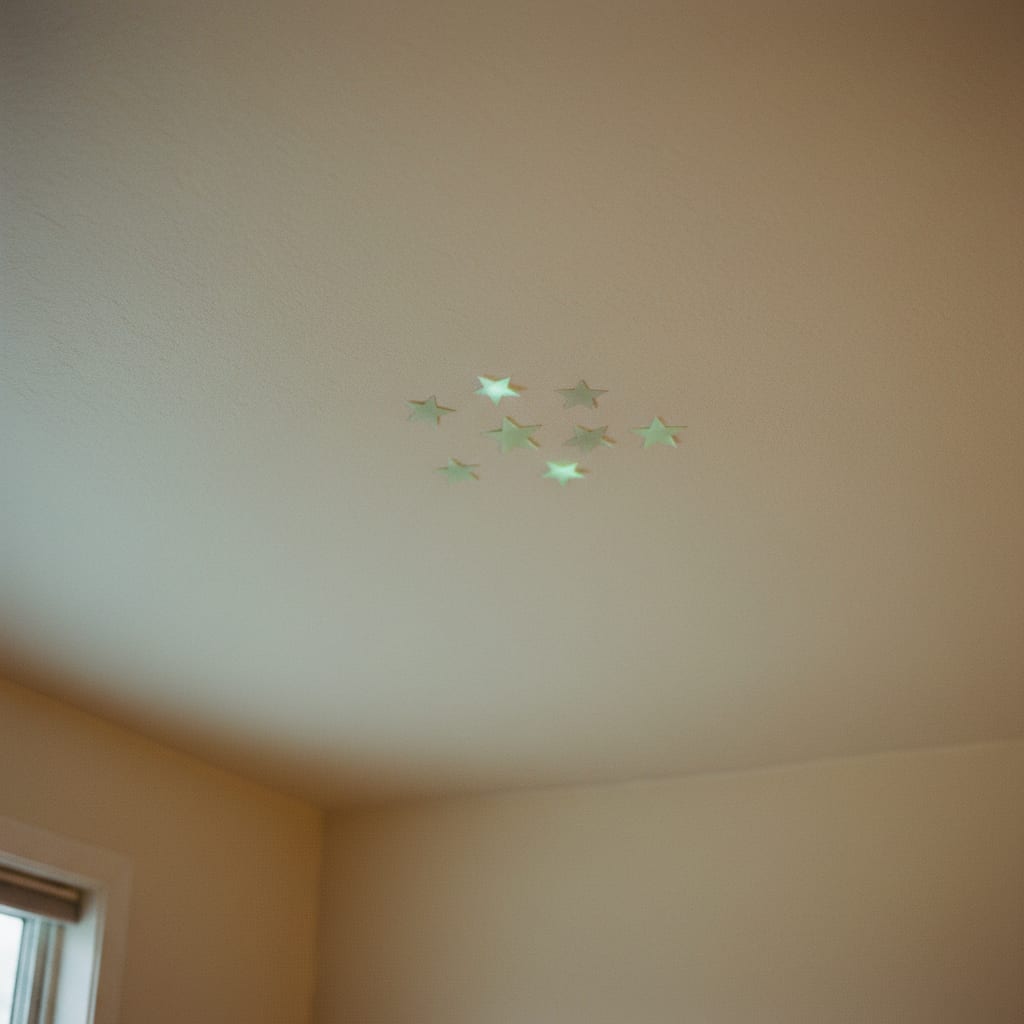
Short answer: for most children over about three, a small cluster of glow-in-the-dark stars on the ceiling is calming, not stimulating. The glow is faint, it never changes color, and it fades on its own: BBC Science Focus says phosphorescent stars shine “for a few minutes after the bedroom lights are switched off”. The trouble comes from three things around them. One is “charging” them with a bright light right before lights-out. Another is putting small stickers where a baby or toddler can reach them. The last is a whole-ceiling galaxy that turns bedtime into a show. Fix those and they’re one of the gentlest things you can put in a bedroom.
How glow stars actually work
Glow stars don’t plug in. They soak up light while the room is lit and give it back slowly once it’s dark. BBC Science Focus explains that phosphorescent materials do their emitting “much more slowly” than fluorescent ones, which is why the stars keep shining for a while after you switch the light off.
That gives them three useful properties:
- They’re brightest at lights-out and only get dimmer. There’s no point in the night when they get brighter.
- They don’t change. No color cycle, no flicker, no rotation. Compare that with a color-changing night light, where the change itself is what wakes children.
- They switch themselves off. You don’t have to come back in, and nothing is left on all night.
Stronger stars glow for longer, but the curve has the same shape: bright at the start, fading from there.
Why they often help
Fear of the dark is normal, and it’s common. Cincinnati Children’s says that as many as 45-80% of kids age 12 and under have a fear of darkness at some point, with a peak around ages 7 to 9. Children’s Hospital Colorado puts it at nearly 75% of children ages 4 to 12 reporting nighttime fears.
Dim light is allowed. Cincinnati Children’s says a night-light is fine for most kids. Its advice is to keep it dim so it doesn’t affect sleep patterns. Glow stars are about as dim as bedroom light gets, and they go out by themselves.
They make the dark interesting rather than empty. Children’s Colorado’s psychologist suggests using a child’s imagination as a tool against fear, and making the dark fun. Cincinnati Children’s suggests a few glow sticks in a dark room to show kids they can handle it. A ceiling of stars does the same job every night.
When glow stars backfire
The charging ritual
This is the big one. Plenty of families “charge” the stars right before lights-out with a phone flashlight or the overhead light. That puts bright light into the last minutes before sleep, exactly the window researchers worry about.
A University of Colorado Boulder study of 3- to 5-year-olds found that light in the hour before bed cut melatonin by an average of 78%, even at 5 to 40 lux, “much dimmer than typical room light.” In most of the children tested, melatonin had still not rebounded 50 minutes after the light went off. The researchers say that doesn’t mean throwing away the night-light. It means keeping evening light to a minimum.
So charge them early. Open the curtains in the afternoon, or let the ordinary room light do it during bath and pajamas. Then let the last part of the routine happen in dim light, the way Betteroo’s guide to ending a toddler’s wind-down in the dark or dim light sets it out.
The novelty week
New stars are exciting, so expect a few nights of counting and pointing. Put them up on a weekend afternoon rather than unveiling them at bedtime.
Too much ceiling
A few dozen stars and a ceiling covered in hundreds are different amounts of light. Children’s Colorado’s advice for fearful kids is not to overdo it: “Try to stick with one dim night light, if anything.” Count the stars as part of that budget. If the room already has a night-light, a cracked door and a streetlight leaking through the curtains, the stars are a fourth source, and one too many.
A projector isn’t the same thing
Some hospital advice, like St. Louis Children’s, suggests a star projector as a creative night-light, alongside a warning that too much bedroom light can disrupt melatonin. A projector is a powered light, though, and many models cycle colors or rotate. Judge it by the same test as any night-light: dim, warm and still.

The safety catch: small stars, small children
Under one, keep it simple. A baby’s crib should be bare, and Betteroo’s checklist for a baby’s sleep space includes placing the crib away from windows, cords and wall decor. It also notes that most babies don’t need a night light until they are past two. Stars on the ceiling are out of reach. Stars on the wall beside a crib are not, once a baby can pull up to stand.
Treat stars and their putty as small objects. HealthyChildren’s choking guidance says to follow the age recommendations on toy packages, keep small household items out of reach of infants and young children, and watch older siblings. It notes that many choking incidents happen when an older brother or sister hands a small object to a younger child. In a shared room, a big sibling’s fallen star can end up in a toddler’s hand. Read the age grade on the pack before you buy.
Painting instead of sticking? Glow paint is still paint, so the same ventilation and timing questions as any freshly painted nursery apply before a baby sleeps in the room.
Room Notes: a capsule ceiling
The same rule that makes a capsule wardrobe work makes a calm ceiling: fewer pieces, chosen on purpose.
- Cluster, don’t carpet. One small constellation reads as decor. A ceiling full of stars reads as a theme park and gives off more light.
- Put it toward the foot of the bed. In view from the pillow, but not directly above their face, so it’s something to look at rather than a light in their eyes.
- Choose stars that disappear by day. Pale cream or off-white stars blend into a white ceiling. A kit like Ultra-Glow’s 200-star ceiling set comes with installation material and a star map, so you can lay out one real constellation instead of a random scatter, and use only part of the pack.
- Ceiling only for under-threes. Keep them out of reach of the bed, and off the wall beside it.
- Charge with daylight. Open the curtains in the afternoon and skip the bedtime flashlight.
- One light source, total. If you add stars, rethink the night-light.
When to take them down
- Bedtime keeps sliding later because your child wants to watch them or recharge them.
- Your child gets up to turn the light on so the stars come back.
- Fears are getting worse, not better. Children’s Colorado says to talk to your pediatrician or a mental health expert if a child’s fear leads to constant sleep loss or extreme anxiety around bedtime.
Taking down half is a reasonable middle step.
FAQ
Are glow-in-the-dark stars bad for sleep?
Usually not. They’re dim, steady and fade on their own. The real risk is charging them with a bright light right before bed, so let daylight do it earlier.
How long do glow-in-the-dark stars glow?
BBC Science Focus says phosphorescent stars shine for a few minutes after the lights go off. Stronger versions last longer, but every kind is brightest at lights-out and fades from there.
Are glow-in-the-dark stars safe in a baby’s room?
On the ceiling, out of reach, yes. Keep them off the wall beside the crib, treat loose stars and the putty as choking hazards, and check the age grade on the pack.
Can glow stars replace a night light?
For a child who mainly wants something to look at as they fall asleep, often yes. For a child who needs light to find the bathroom at night, no: the stars will have faded long before then.
Do glow-in-the-dark stars help with fear of the dark?
They can. Children’s hospitals recommend dim light and making the dark feel fun, and stars do both. If the fear is getting worse or keeping everyone up, talk to your pediatrician.
Keep Reading
The New-Mom Gift Guide: What She Actually Wants in 2026
Gifts new moms actually use — no novelty mugs. The Betteroo sleep app that saved us, the robe that isn't hideous, and more picks grouped by budget.
Abercrombie Curve Love Jeans Review: Honest Fit Notes
An honest Abercrombie Curve Love jeans review from a mom of two: how the fit actually works, sizing quirks, wash-test results, and who should skip them.
The 2026 Gift Guide for Teen Girls (Vetted by an Actual Teen)
Gifts for teen girls, grouped by budget and vetted line-by-line by my fourteen-year-old. What actually lands, what got vetoed, and the receipt rule.