Can't Fall Back Asleep After a Night Waking? Try This
The baby resettles in four minutes and you're awake until 3 a.m. Why that happens, what actually helps, and what to stop doing with your phone at 2 a.m.
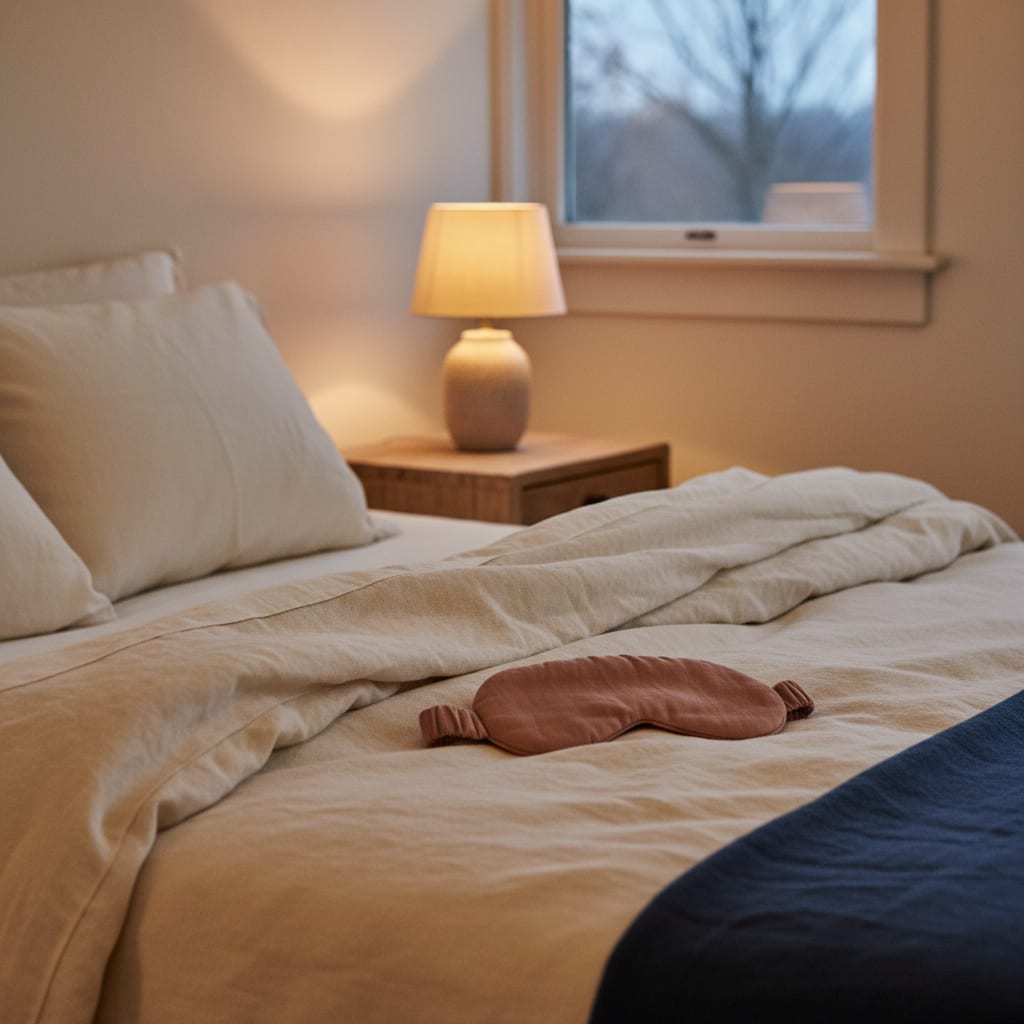
Short answer: don’t check the time, don’t pick up your phone, keep the room dark, and if you’re still awake after roughly twenty minutes, get out of bed and do something dull in dim light until you feel sleepy again. The baby went back down in four minutes because she never fully woke up. You did — you stood up, you made decisions, you turned on a light, and your body treated all of that as morning. The fix is mostly about undoing the wake-up signals rather than trying harder to sleep.
Why you’re the one still awake
Your baby surfaced between sleep cycles, got a hand on her back or a quick feed, and dropped straight back down. Nothing about that required her to be properly awake.
You did the full sequence: heard the cry through a monitor, went from horizontal to vertical, walked into a lit hallway, held a warm body, made a series of small judgment calls, and possibly got cold. That’s a wake-up in every sense that matters. Alertness rises fast and comes down slowly, which is why four minutes of settling can cost you ninety minutes of ceiling-staring.
There’s a second thing nobody warns you about: after months of this, a lot of parents describe lying awake listening, half-braced for the next cry. That keeps a part of you on duty, and being on duty is incompatible with falling asleep.
What to stop doing with your phone
This is the highest-return change on the list, and it’s free.
Stop checking the time. This one first, because everybody does it. The moment you know it’s 2:14 you start doing arithmetic — hours left, how bad tomorrow will be, whether it’s worth trying. That arithmetic is more activating than the waking was, and if you never learn the number you can’t run it.
Stop using the phone as your night light. Even at the lowest brightness, a screen held near your face is a bright, blue-shifted light source pointed straight at the part of your brain that decides whether it’s daytime. A dim, warm lamp on the far side of the room does the job better and costs you far less alertness.
Move the phone out of arm’s reach. Not face-down on the nightstand — across the room. “Just checking” should be a decision you have to stand up to make. If you use it as your alarm, that’s the argument for putting it far enough away that the alarm actually works.
Don’t scroll while feeding. The most common way a fifteen-minute feed becomes an hour awake. An audiobook with the screen dark is a different experience entirely.
The twenty-minute rule
Lying in bed getting frustrated teaches your brain that bed is where you lie awake. Sleep specialists routinely advise the opposite move, and it feels wrong the first few times: if you’ve been awake around twenty minutes, get up.
Not twenty measured minutes — you’re not checking the clock. Twenty felt minutes, which is usually the point where you start being annoyed about it.
Then: leave the bedroom if you can, keep the lights low, and do something genuinely boring. Fold something. Read a few pages of something you’ve read before. No screens, nothing that requires decisions, nothing you’ll want to finish. Go back when you actually feel sleepy rather than when you think you should. The point isn’t the activity — it’s breaking the loop where the bed becomes the place you fail to sleep in.
Set the room up before you need it
At 2 a.m. you have no capacity for problem-solving, so the room has to be right in advance.
Dark, then darker. Every standby glow, the hallway, the crack under the door. If you can’t control the room — the baby’s in it, it’s a rental, the street light is right there — a sleep mask works anyway. A cupped design like the Manta sleep mask blocks light without pressing on your eyes, which is the failure mode of the flat ones, and it means a dim lamp during the feed costs you nothing.
Cool. Being slightly too warm is one of the most common reasons a person who should fall back asleep doesn’t, and the easiest thing here to fix.
Sound, but constant. Steady white noise covers the creak, the neighbour and the half-cry that wasn’t a cry. Anything that varies does the opposite.
A dim path, not an overhead light. One warm low lamp you can reach without standing up is the difference between a partial wake-up and a complete one.
If the room in question is also the living room, the small-space version of all of this is in baby sleep in a small apartment.

Attend fewer wakings in the first place
The real solution to being awake at 3 a.m. is not being woken at 2. Two things move that needle.
Pause before you go in. A baby who resettles in four minutes with you may well have resettled in three without you — babies surface between cycles and make noise doing it, and not all of it is a request. Waiting a couple of minutes is not the same as leaving her to cry, and it’s the change most likely to reduce how often you get vertical. Betteroo’s guide to when babies start to self-settle is a realistic read on what’s developmentally fair to expect at each age.
Split the night, don’t share it. If there are two of you, alternating wakings means you both sleep badly. Assign whole halves instead — one person owns until 2, the other after — so each of you gets one unbroken block, which is worth more than the same hours in fragments.
If the wakings are the pattern rather than the exception, that’s a schedule question, not a willpower one — how night sleep consolidates with age sets a realistic baseline first.
What you sleep in matters more than you’d think
This is a fabric problem as much as a sleep one, and it’s the part most people never revisit.
Fleece and heavy brushed-poly pajamas trap heat and hold moisture, so if you wake at 2 a.m. already too warm, getting back to sleep is a losing battle. A breathable fiber — cotton, bamboo viscose, a light merino in winter — moves heat away instead of banking it. The same logic applies one layer out: natural fills and lighter weights let you run cooler than a heavy synthetic duvet does. It’s the argument behind most of what I liked in my Lincove bedding review — spend on the pieces that regulate temperature, not the ones that feel plush in the shop.
The morning after
You won’t fix a lost night at 3 a.m., but you can stop it becoming a lost week: normal-ish wake time, morning light early, naps at their usual length, bedtime slightly earlier. The full version is in how to reset the day after a bad night.
FAQ
Why can’t I fall back asleep after my baby wakes up?
Because you woke up more than she did. Standing, walking into light, holding a baby and making decisions all raise alertness, and alertness falls far more slowly than it rises. Checking the time and looking at a screen extend it.
Should I check the time when I wake up at night?
No. Knowing the number starts the mental arithmetic about how much sleep is left, and that calculation is more activating than the waking itself. Turn any glowing clock away from the bed and keep your phone out of reach.
How long should I lie there before getting up?
Roughly twenty minutes, judged by feel rather than by clock-watching. If you’re awake and getting frustrated, get up, keep the lights dim, and do something boring until you’re sleepy. It breaks the association between your bed and lying awake.
Does my phone really keep me awake at night?
The screen is a bright light held close to your face at the moment you’re trying to convince your body it’s still night, and the content is built to hold attention. Both work against you.
What if I’m awake because I’m listening for the baby?
That’s extremely common and it’s real — part of you stays on duty. Steady white noise helps by covering the small sounds that aren’t calls for you, and splitting the night into shifts with a partner helps more, because being formally off duty is what lets you stop listening.
Keep Reading

The New-Mom Gift Guide: What She Actually Wants in 2026
Gifts new moms actually use — no novelty mugs. The Betteroo sleep app that saved us, the robe that isn't hideous, and more picks grouped by budget.
Best Slippers for Women: Warm, Supportive and Door-Ready
The best slippers for women, sorted by job: shearling for cold floors, wool for warm houses, arch support for sore feet, and a washable pair for real life.
Starting Preschool? Why Bedtime Falls Apart for 2 Weeks
Starting preschool or nursery wrecks bedtime for about a fortnight. What the first two weeks actually do to a child's day, what to change, and what to leave alone.