Swaddle to Sleep Sack: The Arms-Out Transition Week
How to move a baby from swaddle to sleep sack without losing nights — what separates the sack styles, the week-long plan, and what to layer underneath.
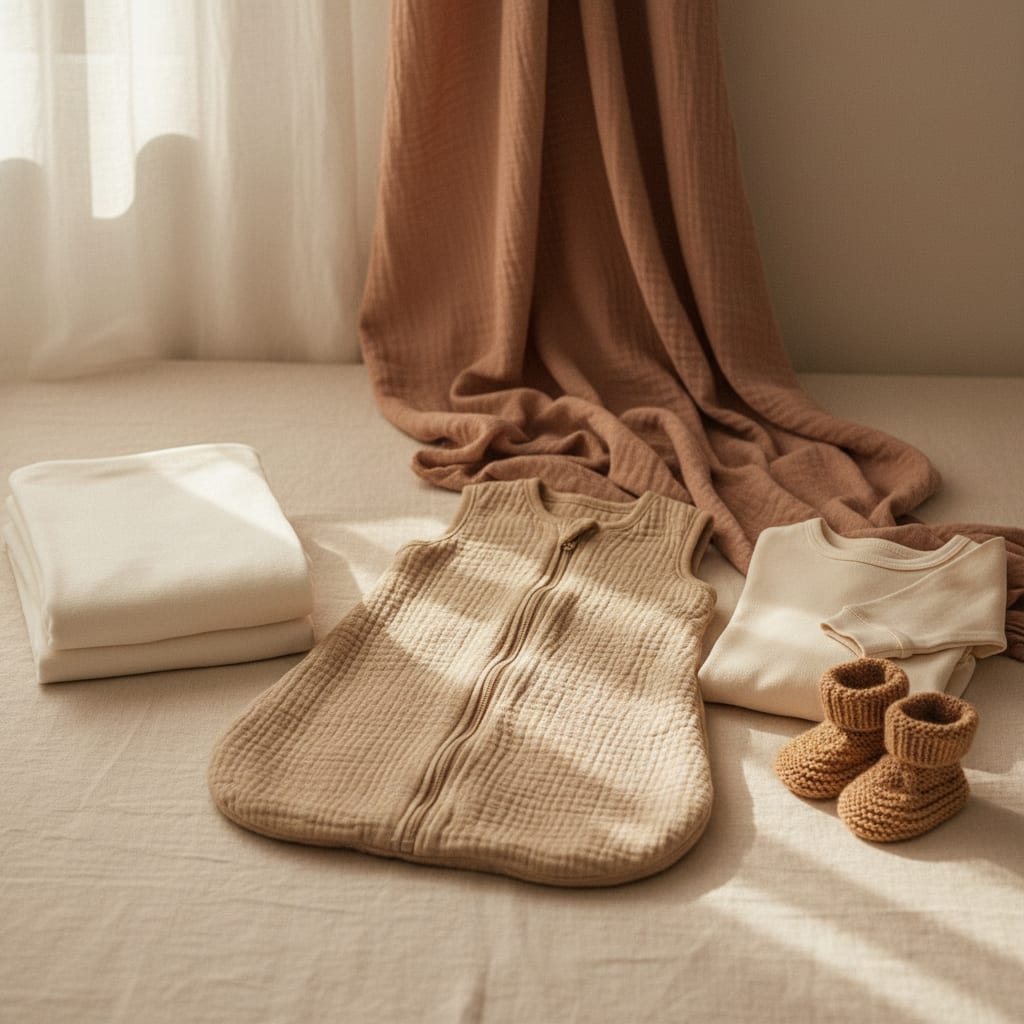
Short answer: swap the swaddle for an arms-out sleep sack as soon as your baby shows any sign of rolling — and do it in one clean move rather than a slow taper, because the adjustment takes roughly three to seven nights either way. Safe-sleep guidance is unambiguous on the timing: once a baby can roll, a swaddle that pins the arms is no longer safe, and that’s often around two months, sometimes earlier. The good news is the transition is short, and most of what makes it feel long is choosing the wrong sack.
I think about this the way I think about swapping a coat for a jacket. The garment changes; the job doesn’t. Baby still needs the same warmth, the same snugness at the neck, the same “nothing loose in the bed” rule — it’s the arms that change.
Why the swaddle has to go, and when
The trigger isn’t an age, it’s a movement. Rolling, arching onto one side, pushing up on an elbow during tummy time — any of those means the swaddle stops that day. A baby who rolls onto their front with their arms wrapped can’t push their head up or shift position, which is the specific risk safe-sleep guidance is built around.
Two things make this easier to accept. First, arms-up is a baby’s natural sleeping posture — Betteroo’s explainer on the arms-up sleeping position covers why the startle reflex and the flexed-arm posture go together, and why free arms aren’t the disaster they feel like at 2 a.m. Second, the reflex you’re worried about is fading anyway. Betteroo’s timeline on when babies start rolling is worth reading a few weeks before you think you’ll need it, because rolling almost always arrives before parents expect it.
The four styles, and what actually differs between them
Every product in this category is a bag with a neck hole. What separates them is exactly three variables: how the arms are handled, how the fabric is weighted, and how it opens.
The adjustable swaddle-to-sack. A swaddle whose wings can be set arms-in, one-arm-out, or both-arms-out. The HALO 100% cotton Sleepsack Swaddle is the archetype — three-way fasteners, an inverted zip that opens from the bottom for changes, and a 1.5 TOG cotton weight. It’s the cheapest route through the transition because it’s one garment doing both jobs.
The zip-off-wings sack. The Love to Dream Swaddle Up Transition Bag works differently: the arms sit up in a wing shape rather than pinned down, and the wings unzip — one at a time, or both. Sizes run by weight rather than age, with the medium covering roughly 13 to 18.5 lb. If your baby fought the traditional arms-down swaddle from day one, this shape is usually why.
The plain arms-out sack. No wings, no options, just a bag. This is where you end up, and it’s the one you’ll buy several of. Choosing the weight is the only real decision, and that’s a room-temperature question rather than a season question — the numbers and the layering chart live in my sleep sack TOG guide.
The padded transition suit. The Baby Merlin’s Magic Sleepsuit is a three-layer suit — cotton or microfleece outer, cotton inner, polyfill between — with arms and legs free but heavily dampened, plus a double zip for changes. Be clear-eyed about it: the maker’s own instruction is to stop using it at the first sign of rolling, exactly like a swaddle. So it’s a tool for a baby who has outgrown the swaddle’s snugness but is not yet rolling, and it is not the answer once rolling starts.
The transition week, night by night
The method that works is boring and short.
Nights 1–2: one arm out. Whichever product you’re using, free the dominant arm and leave the other contained. This halves the startle without removing the sensation of being held.
Nights 3–4: both arms out. Do it at bedtime, not at a 3 a.m. wake-up, when everyone’s resources are lowest. Expect the first-half-of-night stretch to shorten before it lengthens again.
Nights 5–7: hold the line. This is the part where people quit. The pattern almost everyone reports is that nights three and four are the worst and night six is noticeably better. Reverting to the swaddle at hour two of night four resets the clock and teaches nothing.
Two things that measurably help and cost nothing: keep every other variable frozen for the week — same room, same routine, same feed timing, no new bedtime — and give it the full seven nights before you conclude anything. Changing two things at once means learning nothing about either.
What goes underneath, and why the layer changes
Here’s the part that catches people out, and it’s a garment-weight problem, not a sleep problem. A swaddle wraps two fabric layers around the torso. An arms-out sack is a single layer, and it leaves the arms bare. Swap like-for-like and you have made the whole outfit meaningfully cooler on the same night, in the same room.
So the layer underneath usually goes up one step at the same moment the arms come out: a short-sleeve bodysuit becomes a long-sleeve one, or a long-sleeve bodysuit becomes lightweight footed pyjamas. Check the chest or the back of the neck rather than the hands — hands run cool on babies as a matter of course, and cold hands during an arms-out week are the single most common false alarm there is. Warm and dry at the chest is the target. My guide to dressing a baby for cold nights has the fibre-by-fibre version of this, and the same principle applies here: change the layer underneath before you change the bag.
When it isn’t working
If you’re four or five nights in and it’s genuinely worse rather than differently bad, the variable is usually not the sack. The three real suspects are an overtired baby going in too late, a wake window that’s drifted, or a schedule that had already stopped fitting before the swaddle came off. A transition week magnifies an existing scheduling problem; it rarely creates one.
That’s the point at which a plan built around your own baby’s age and pattern beats another product. Betteroo’s two-minute plan builder takes a couple of minutes and tells you which of the three you’re looking at. And for surviving the day after a rough night without wrecking the next one, I wrote the recovery playbook in how to reset after a bad night.
FAQ
When should I stop swaddling my baby?
At the first sign of rolling — including rolling onto one side or pushing up during tummy time — regardless of age. For many babies that’s around two months, and it can be earlier. Age is a guideline; the movement is the rule.
Should I transition out of the swaddle gradually or all at once?
One arm for a couple of nights, then both, is the standard approach and the one most parents find easiest. A slower taper doesn’t shorten the adjustment. What matters far more is not reverting mid-week, because going back and forth restarts the process each time.
How long does the swaddle transition take?
Usually three to seven nights, with nights three and four typically the hardest. If you’re past a week with no improvement at all, look at the schedule and wake windows rather than the sleepwear.
What should my baby wear under an arms-out sleep sack?
Usually one layer more than they wore under the swaddle, because the swaddle was adding a fabric layer around the torso and the arms are now bare. Pick it by the room’s overnight temperature, and check warmth at the chest or back of the neck rather than the hands.
Is a sleep sack safe once my baby can roll?
Yes — that’s precisely what it’s for. An arms-out sack leaves the arms free to push and reposition, which is the ability a swaddle removes. Keep the neck opening and armholes snug enough that the bag can’t ride up, and keep the sleep space otherwise empty.
Keep Reading

The New-Mom Gift Guide: What She Actually Wants in 2026
Gifts new moms actually use — no novelty mugs. The Betteroo sleep app that saved us, the robe that isn't hideous, and more picks grouped by budget.

Toddler Takes Diaper Off at Night? What to Dress Them In
Why a toddler pulls their diaper off at night, from a wet diaper to a brand-new undressing skill, and the sleepwear that closes the exits without a fight.

What Is Semi-Formal Attire? What to Wear, Translated
Semi-formal attire, decoded: where it sits against cocktail and business dress, what women and men actually wear, and how the time of day changes the answer.