Best Clogs for Women: Fall's Easiest Shoe, Ranked
The best clogs for women this fall — suede, leather and shearling picks compared on footbed, sizing and what each one is built for, plus how to style them.
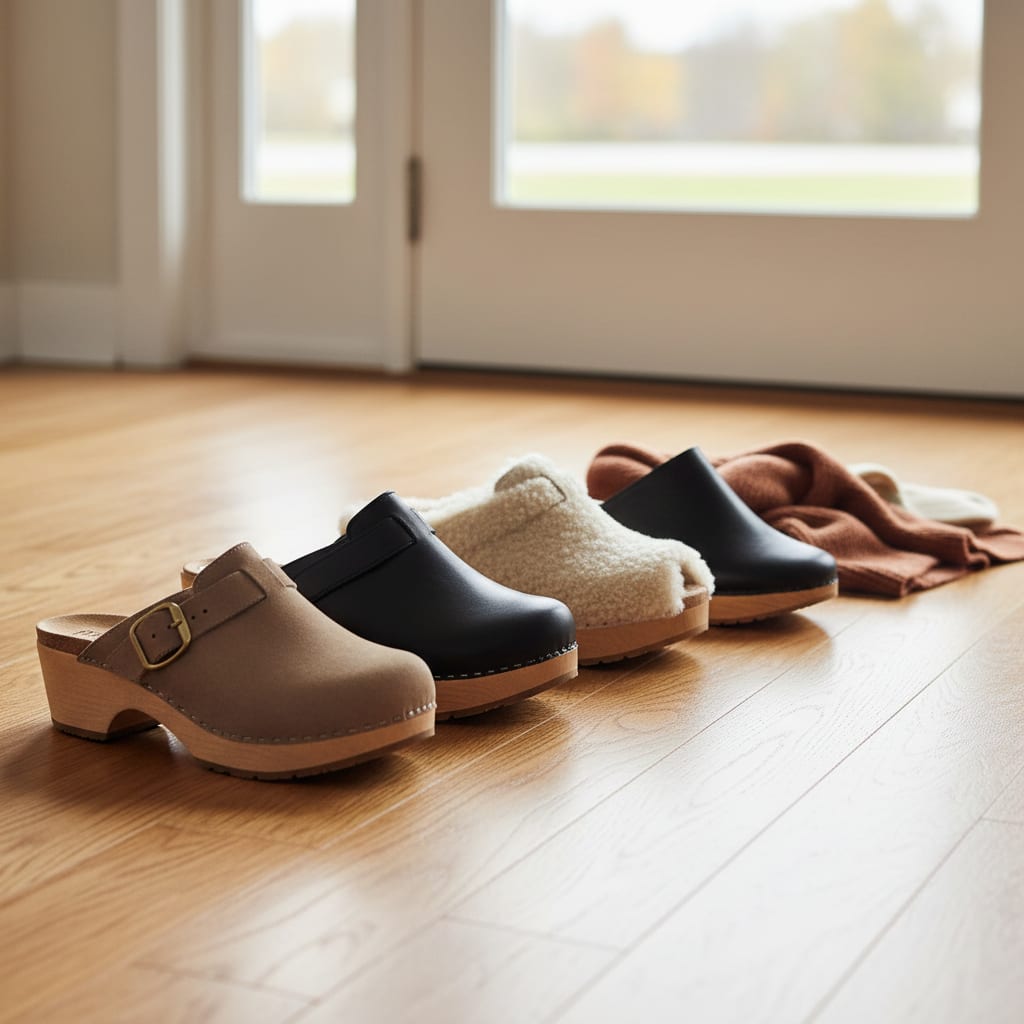
Short answer: the best all-round clog for most women is a suede clog on a cork footbed with an adjustable buckle — the Birkenstock Boston shape — because it’s the only version that works with socks in October and bare feet in September. A clog is a backless shoe you step into, which is the entire reason it took over fall: no laces, no bending down, no negotiation. Below are six worth owning, split by what they’re actually built to do.
Why the clog owns fall specifically
A clog is a shoulder-season shoe by construction. The open back means it never overheats the way a boot does in a mild week, and the closed toe means it works when the mornings go cold. Add a sock and it’s a November shoe; take the sock off and it’s a September shoe.
The second reason is the school run: a shoe you can step into while holding a lunchbox wins on physics alone, and clogs are the only closed-toe option that qualifies.
The six, by job
1. Birkenstock Boston Soft Footbed — the one everybody means. Suede upper, cork-and-latex footbed, EVA outsole, one adjustable buckle. The “Soft Footbed” version adds a foam layer under the lining, which shortens the famously stubborn break-in period considerably. If you’re buying one clog, buy this shape.
Fit Notes: Birkenstock sizes in EU and sells regular and narrow widths — the buckle is what makes it work across foot shapes, so check that you’re on a middle hole rather than the last one. The cork moulds to your foot over the first few weeks and then stops changing.
2. Birkenstock Boston Shearling — the cold-morning version. Same cork-and-latex footbed, same suede upper, same EVA sole, with a shearling lining through the toe box. It’s the version that carries the shape from October into February without a sock, and it’s noticeably warmer than a lined synthetic.
Fit Notes: the shearling takes up real volume, and Birkenstock’s own listing notes this style fits narrow. Size accordingly and expect the lining to compress a little in the first month, which loosens the fit slightly rather than tightening it.
3. Dansko Professional — the all-day workhorse. Leather upper, contoured footbed, reinforced roomy toe box, padded instep collar, a protective heel counter and an anti-fatigue rocker bottom on a polyurethane outsole. This is the shoe nurses and chefs wear through twelve-hour shifts, and the engineering is genuinely different from a fashion clog: the rocker sole does part of the work of walking for you.
Fit Notes: the fit is famously roomy and the shoe is heavy — that mass is structure, not padding. It runs in EU sizing and the toe box is generous, so many people size down from their usual clog size. Not a subtle shoe; that’s rather the point.
4. CUSHIONAIRE Granola — the budget suede. Genuine suede upper on a cork footbed with a platform, and wide widths available, which is the detail that makes it a genuine option rather than a compromise. Cushionaire is the brand that keeps turning up in my dupe research for the same reason: it puts real suede on a cork bed at a low price, which almost nobody else in the bracket does.
Fit Notes: the platform adds height and a slightly chunkier line than the Boston. Suede at this price spots in rain, so treat it with a protector spray before the first wear. It’s the same materials logic I laid out in the Birkenstock Boston dupe roundup.
5. CUSHIONAIRE Hana — the vegan option. Vegan suede on a cork footbed with arch support and a rounded, chunky toe. Synthetic suede doesn’t breathe like the real thing, so it’s a cooler-weather shoe than a bare-foot September shoe, but it’s the cleanest non-leather version of this silhouette at a normal price.
Fit Notes: the rounded toe runs generous, and vegan suede doesn’t stretch the way real suede does — buy the fit you want on day one.
6. Dr. Scholl’s Rate Mule — the one you can wear to something. A loafer-inspired mule with a penny strap and a one-inch stacked heel. It sits at the dressier end of the clog family: closed toe, backless, but with a heel and a hard sole that read as a shoe rather than a comfort item. The pick for a school concert or an office day.
Fit Notes: backless mules with a stacked heel can slap at the heel when you walk fast. A snugger fit through the vamp is what stops that, so this is a style to buy true to size rather than roomy.
Cork, wood or foam — what’s under your foot
| Footbed | Feels like | Ages by | Best for |
|---|---|---|---|
| Cork and latex | Firm at first, then moulded to you | Compressing to your shape, then holding | All-day walking, arch support |
| Wood (traditional) | Rigid, no give | Barely changing at all | Short wear, dressier styles |
| Moulded foam / memory foam | Soft immediately | Flattening over a season | Comfort now, less support later |
| Polyurethane with a rocker | Cushioned and propulsive | Slowly, it’s an industrial sole | Standing shifts, long days |
The trade is simple: soft-immediately footbeds flatten, and firm-at-first footbeds last. If you’re on your feet, buy cork or a rocker sole and accept two uncomfortable weeks.
Sizing a clog, properly
Clogs are the shoe people most often buy wrong, and it’s the same three mistakes:
Too big, so it slips. A backless shoe stays on by gripping the top of your foot, not by holding your heel. If your toes have to claw, it’s too big. Your heel should sit about a centimetre from the back edge of the footbed — not hanging off, not jammed forward.
Ignoring width. Half the clog market sells widths and most people never check. A narrow foot in a regular-width Boston will slop no matter what hole the buckle is on.
Buying to the season you’re in. If it’ll be a sock shoe by November, try it on with the sock. A wool sock is easily a half size of volume.
Styling clogs without looking costumed
Two rules cover nearly everything. First, mind the hem — a clog is a chunky, horizontal shoe, so it wants either a cropped straight jean that ends above the ankle bone or a proper full-length wide leg that covers the strap. The awkward zone is a hem that stops mid-clog. Second, the sock is a colour decision: matched to the trouser it disappears and lengthens the leg, contrasted it becomes the loudest thing you’re wearing.
Beyond that, a clog slots straight into the shoe rotation in my fall capsule wardrobe, taking the slot between a sneaker and a boot. And if what you actually want is the cosy backless shape rather than the structured one, the Ugg Tasman lane is the softer cousin of this whole category.
FAQ
Are clogs comfortable for all-day wear?
Cork-footbed and rocker-soled clogs are — that’s what Dansko and Birkenstock are built for. Fashion clogs on thin foam are comfortable for a few hours and then aren’t. The rule of thumb: if it feels perfect in the first five minutes, it probably won’t in the fifth hour.
Do you wear socks with clogs?
In fall and winter, yes, and it’s now the standard way to wear them. A ribbed crew sock in the same tone as your trousers is the safe version; a contrast sock is a deliberate statement. In warm weather most clog styles are worn bare, which is where suede-lined footbeds beat synthetic ones.
What’s the difference between a clog and a mule?
A clog traditionally has a thick, rigid sole and a closed toe, often with a defined footbed. A mule is any backless shoe, including flats and heels. Every clog is a mule; most mules are not clogs.
How should clogs fit?
Snug across the top of the foot, with your heel roughly a centimetre from the back edge of the footbed and your toes clear of the front. Backless shoes stay on through the top strap, so a loose vamp is what makes a clog flap and slip, not a loose heel.
Are expensive clogs worth it over cheap ones?
For daily wear, yes, and the reason is the footbed rather than the upper. Cork and rocker soles hold their support for years; moulded foam flattens in a season or two. For occasional wear, a suede-on-cork budget pair gets you most of the way there.
Keep Reading
The New-Mom Gift Guide: What She Actually Wants in 2026
Gifts new moms actually use — no novelty mugs. The Betteroo sleep app that saved us, the robe that isn't hideous, and more picks grouped by budget.
Postpartum Capsule Wardrobe: Real Clothes That Fit Now
A postpartum capsule wardrobe that fits the body you have today: 16 forgiving, nursing-friendly pieces, the sizing rules, and what not to buy yet.
Sunburned Child Can't Sleep? How to Help Them Settle
How to help a sunburned child sleep after a beach day: a cool bath, aloe, what to wear to bed over a burn, the sheets, and when sunburn needs a doctor.