Short answer: no. Take the headband or hair bow off before every nap and every bedtime, including the quick car-seat or stroller doze. A stretchy band can slide down over a sleeping baby’s eyes, nose and mouth, and a baby can’t push it back up. A bow that comes loose is a small object in the sleep space. The safe-sleep rule is simple: a baby under 12 months sleeps on their back, on a flat, bare surface, with the head and face uncovered. A headband is for awake time, when someone is watching.
Why a headband and sleep don’t mix
The National Institutes of Health’s Safe to Sleep campaign puts it in one line on its ways to reduce baby’s risk page: “keep baby’s head and face uncovered during sleep.” It also explains why overheated babies are at higher risk for SIDS.
A headband breaks that rule in two ways:
- It can slip. Baby headbands are soft and stretchy so they don’t pinch, which also means they move. A baby who rubs their head on the mattress, or turns side to side, can push a band down over the eyes and onto the nose and mouth. Unlike an older child, a young baby can’t pull it back up.
- It adds a loose piece. The American Academy of Pediatrics’ (AAP) parent’s guide to safe sleep says soft objects and loose bedding “can increase your baby’s risk of entrapment, suffocation or strangulation.” A band that has slipped off the head and lies loose in the crib is exactly that kind of object.
UK parenting site MadeForMums wrote about this in 2019 in why headbands aren’t safe while your baby’s sleeping. It reported a widely shared case of a baby who died after a big-bow headband slipped over her nose and mouth while she slept in a carrycot. The same article quotes the Lullaby Trust: “Head-covering can lead to overheating which can increase the risk of SIDS (sudden infant death syndrome) or suffocation.” MadeForMums’ conclusion is the sensible one: headbands are fine when your baby is awake, but take them off before a nap, and whenever you can’t watch your baby closely.
The bow itself: a small-parts problem
Even a band that stays put carries a second risk: the decoration. Bows, flowers, pearls and little clips are glued or stitched on, and babies pull at whatever is on their heads.
The AAP’s page on choking prevention says babies and toddlers are at the highest risk of choking because they explore by putting things in their mouths. It advises avoiding toys with small or detachable parts. Treat a bow the same way. A decoration that is only a bit loose at breakfast can be fully loose by the afternoon nap. Check it each time it goes on, and throw away any band with a wobbly bow rather than gluing it back.
The nap-time handoff: where the bow goes
The easy way to make this stick is to give the bow a place to go. Think of it like the coat rule in my winter coat and car seat guide: the outfit changes at a set moment, every time, so nobody has to remember.
- The bedroom door. Bow off as you walk in for the nap routine, with the diaper change and the sleep sack. Same order every time.
- The car seat. Babies fall asleep in the car all the time, and the AAP says that if a baby falls asleep in a car seat, stroller or carrier, you should move them to a firm, flat sleep surface on their back as soon as possible. Take the headband off when you buckle them in for any drive long enough to doze. You can’t watch the band from the driver’s seat.
- The carrier and the stroller. Same rule: if the eyes are getting heavy, the bow comes off.
- Someone else’s house. Tell grandparents and sitters the bow goes in the diaper bag before any nap.
A small wall organizer by the changing table, like this YOcity bow organizer, gives bows a home in the room you’re already in at nap time. Hang it on the wall away from the crib, so nothing with a ribbon or hook is within reach of the sleep space.
 Naps falling apart anyway?
Betteroo builds an age-specific nap and bedtime plan around your baby's real day, and adjusts it when things change.
Take the quick sleep quiz →
What to dress the head in for sleep: nothing
If the reason for the headband is warmth, the answer is the same as for hats. The AAP’s guide says, “Don’t put a hat on your baby while indoors once you’re home from the hospital,” because overheating can increase the risk of SIDS. Warmth for sleep comes from the room and the sleep sack, not from anything on the head. Keep the room at about 68 to 72°F (20 to 22°C) and choose a sleep bag by TOG, such as the Kyte Baby 2.5 TOG sleep bag for a cooler room. The hat question has its own post: should a baby sleep in a hat.
The same rule covers the other head-and-neck accessories. A baby’s first earrings should be flat studs for the same reason: nothing that dangles, catches or presses. The details are in baby ear piercing and sleep. And no necklaces, bracelets or anklets on a sleeping baby either. Anything that can loop round a neck or wrist adds the kind of strangulation risk the AAP’s soft-objects rule exists to prevent.
Choosing headbands for awake time
The bow can still be part of the outfit. A few choices make awake time safer:
- Soft nylon over tight elastic. A wide, very stretchy nylon band leaves no red line on the forehead. If it leaves a mark after an hour, it’s too tight.
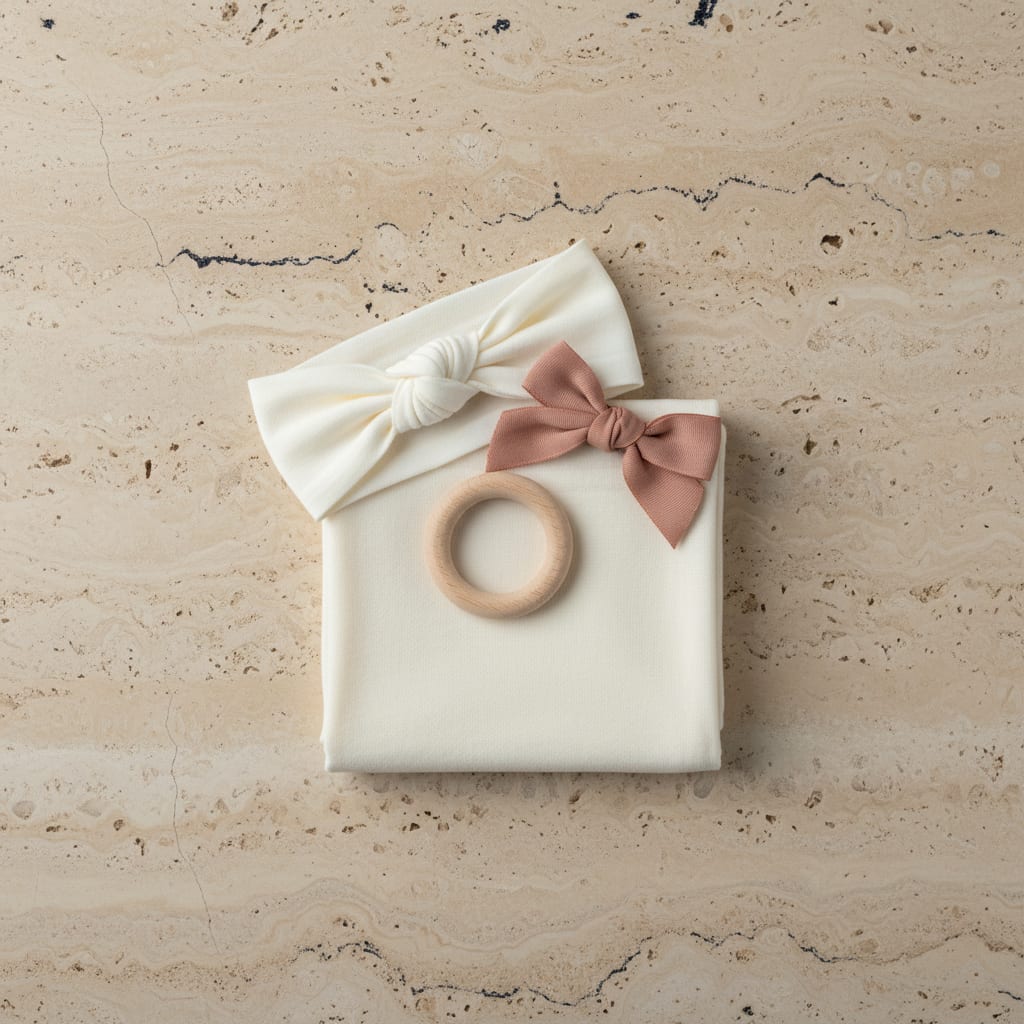
- Knotted or stitched, not glued. A soft knot made of the band’s own fabric has nothing to come off. These CÉLLOT stretchy knot headbands are a set of soft nylon wraps with bows in the same fabric.
- Small and flat. A big bow gives a baby more to grab and pushes the band around during floor play.
- Photo-session rule. For a family photo, put the bow on for the shoot and take it off before the car ride home.
When can a child sleep in a hair accessory?
The AAP’s safe-sleep rules cover the first year. The Betteroo guide on why the first year’s sleep rules last until the first birthday explains that the risk drops after the early months but doesn’t end until 12 months. So before the first birthday, the answer is a firm no.
After that, the main concern is the decoration rather than the band. Toddlers still put things in their mouths. Clips, beads and bows stay out of the crib or bed until your child stops mouthing things. For a toddler with long hair, a soft fabric scrunchie or a loose braid does the job of keeping hair tidy overnight. The method is in kids’ bonnets and braids at bedtime.
FAQ
Can a baby nap with a headband on if I’m watching?
The safe-sleep rule is to keep a sleeping baby’s head and face uncovered, so take it off for every nap, even a supervised one. You’ll look away at some point, and a band can slide down quickly.
Can my baby wear a headband in the car seat?
Not for a drive where they might fall asleep. You can’t watch the headband while driving, and a dozing baby can rub it down over the face. Take it off at buckle-up and put it back on at the other end.
Are hair clips safer than headbands for a baby?
Not for sleep. A clip has nothing to slip over the face, but it’s a small, hard object that can come loose, and the AAP lists small detachable parts as a choking hazard for babies. Clips come out before naps too.
What about a headband for a baby with no hair, for photos?
That’s fine while someone is holding or watching the baby. Take it off before the baby is put down, and check that it leaves no red mark on the forehead.