Short answer: if you pierce a baby’s ears, choose a small, round, flat gold stud, have it done by a doctor, nurse or experienced piercer, and leave that stud in for at least six weeks, nights included. A flat stud is the earring a baby can lie on. Sleep rules don’t change for a new piercing: a baby under 12 months still goes down flat on their back, on a bare mattress, with nothing propping the head off the sore ear. The American Academy of Pediatrics (AAP) says there’s little risk at any age when the piercing is done carefully, but its general guideline is to wait until a child can care for the piercing themselves.
First, the timing question
The AAP’s page on avoiding infection after ear piercing says ears “may be pierced for cosmetic reasons at any age,” and that if the piercing is done carefully and cared for properly, “there is little risk, no matter what the age of the child.” Then it adds a general guideline: postpone it “until your child is mature enough to take care of the pierced site themselves.”
University of Utah Health’s article Ear Piercing: How Young Is Too Young? notes that in Spain and Latin America it’s customary to pierce a baby girl’s ears days after birth. Pediatrician Alanna Brickley, MD, calls it “a fairly safe procedure to do, as long as it’s done in a safe setting,” and advises waiting until your child has had at least one tetanus vaccine.
So if you’re piercing early, ask your pediatrician about timing at a well visit. And if you can, don’t book it the same week as a big sleep change, like the swaddle to sleep sack switch. One new thing at a time.
Choosing the first earring: the style rules
A baby’s first pair comes down to metal, shape and how flat it sits.
Metal: gold
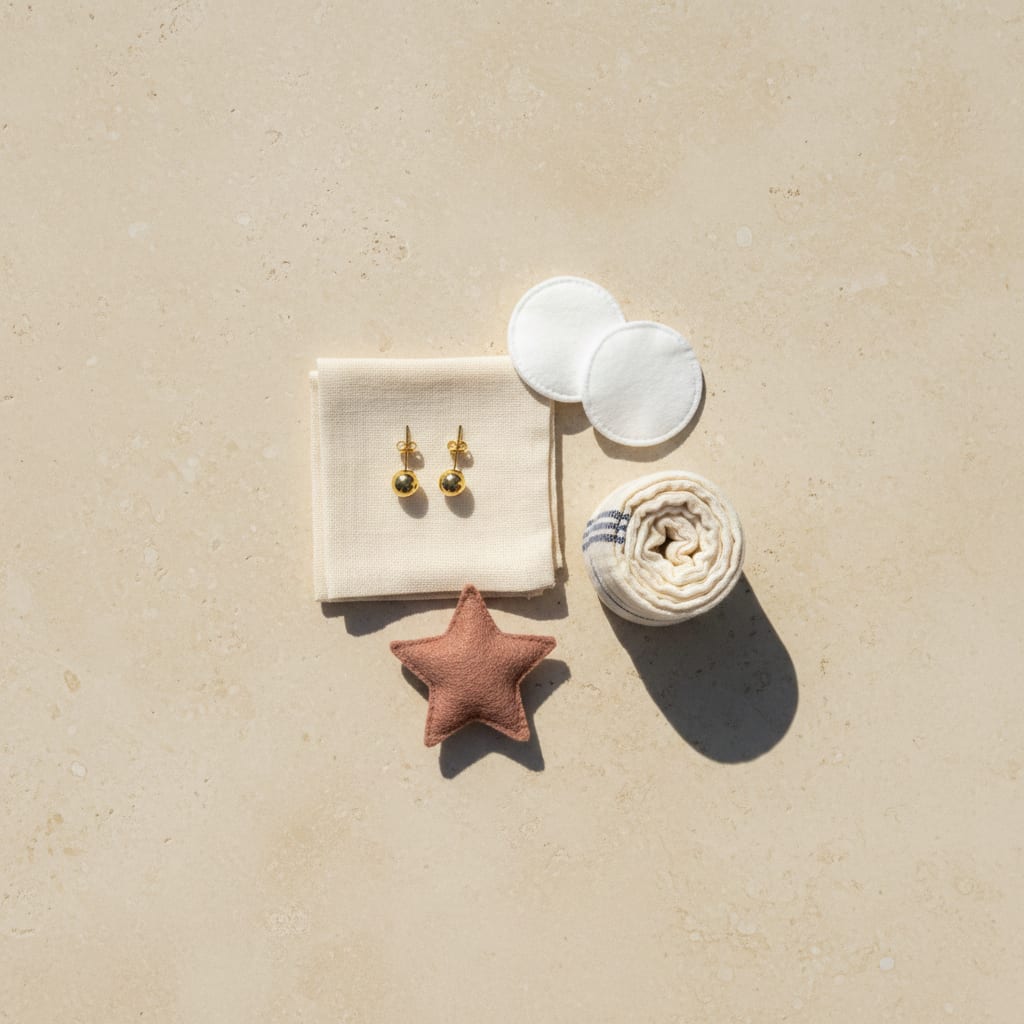
The AAP says a round, gold-post earring should go in at the time of the piercing, and that “the gold in the posts will reduce the risk of an allergic reaction and inflammation.” That’s the brief. A plain yellow-gold ball, such as these 14k yellow gold 4mm ball studs with screw backs, is the classic.
Shape: small, round, flat
Dr. Brickley’s advice is to use earrings that are “very small, round, and as flat as possible,” and to never use dangling earrings, “as they could get caught and tear the earlobe.” That rules out drops, charms, little hoops and anything with a point.
Fit Notes: look at the earring from the side, not just the front. The flatter the front and the back, the less there is to press into the earlobe when your baby’s head turns to that side on the mattress. A tiny ball is fine. A raised setting with prongs is a toddler-and-up earring.
Where it’s done
Both sources set the same bar. The AAP says to have a doctor, nurse or experienced technician do it. Dr. Brickley suggests an established, reputable business, checking that the equipment is cleaned and that staff are comfortable piercing a child, and avoiding piercing guns, “as they cannot be adequately sterilized.” The AAP also notes that some piercing instruments put the gold post in place at the same time, which avoids extra probing that can raise the chance of infection.
Sleep with a new piercing: what stays the same
Back to sleep, every time. The AAP’s parent’s guide to safe sleep says to place your baby on their back for all naps and at night, and that the side position “is just as dangerous as the stomach position.” A sore earlobe doesn’t change that.
Nothing to prop the head. No rolled towel, pillow or wedge to keep one ear off the mattress. The same guide says no blankets, pillows, stuffed toys or bumper pads in the crib, and to choose a firm, flat sleep surface.
No hat or headband over the ears. It’s tempting to “protect” the earrings. The AAP says not to put a hat on a baby indoors once you’re home from the hospital, so nothing goes over the ears for sleep. More in should a baby sleep in a hat.
Rollers can stay where they land. The AAP guide says you should always place your baby down on their back, but if they’re comfortable rolling both ways, you don’t need to keep turning them back. Betteroo’s guide puts it the same way: once a baby rolls back to tummy and tummy to back on their own, you don’t need to reposition them at night. That holds even if they end up on the pierced side.
What you can change is the earring. Your baby will lie on that ear at some point, which is why the flat stud matters.
Aftercare that fits a bedtime routine
Leave the starter studs in. The AAP says not to remove the earring for four to six weeks. The American Academy of Dermatology’s tips for caring for new piercings says six weeks or more, “even at night,” because taking them out early can let the holes close.
The cleaning advice differs a little between sources, so ask your pediatrician or piercer which to follow:
| Source | What it says |
|---|---|
| AAP | Rubbing alcohol or antibiotic ointment twice a day for a few days. Rotate the earring gently each day. |
| University of Utah Health | Wash your hands first. Clean twice a day for about two weeks with soap and water. |
| AAD | Gently wash at least once a day with a mild, fragrance-free cleanser, then rinse well. Avoid hydrogen peroxide and antibacterial soaps. Apply a thin coat of petroleum jelly from a squeeze tube. |
The AAD’s squeeze-tube point is practical: a tube, such as this Vaseline healing jelly squeeze tube, means you aren’t dipping a finger into an open jar.
Attach it to steps you already do: after the morning diaper change, and after bath, before pajamas. Two short slots, the same every day.
 Fussy nights after a new piercing?
Betteroo builds an age-specific sleep plan around your baby's real patterns, so a rough week doesn't undo the routine.
Take the quick sleep quiz →
When it looks wrong
Some redness and irritation at first is normal, according to Dr. Brickley. All three sources describe signs that mean you should call:
- The AAP: if the area becomes red or tender, an infection may be developing, so seek medical attention promptly.
- University of Utah Health: call your doctor if your child runs a fever, or the earlobe gets very red and swollen.
- The AAD: soreness, redness or puffiness, or a hole that oozes yellowish liquid, can mean infection. Raised skin around the hole may be a keloid, a type of scar.
After the six weeks: the first earring capsule
Once the holes have healed and your pediatrician or piercer is happy, you can build a tiny wardrobe. Keep it in the same family as the first pair:
- The everyday stud: the plain gold ball they started with.
- One “occasion” stud: still small, round and flat, perhaps a slightly larger ball for photos.
- Nothing that dangles while they’re small enough to grab, nap in a car seat or sleep on that ear, following Dr. Brickley’s advice.
Once your baby is a toddler, the night rules for other accessories are in kids’ bonnets and braids at bedtime.
FAQ
Can a baby sleep on a newly pierced ear?
If they roll there on their own, yes. Always place a baby under 12 months down on their back, and don’t prop the head to keep the ear off the mattress. A small, flat stud is the practical choice for a baby who will lie on that ear.
What age is best to pierce a baby’s ears?
The AAP says there’s little risk at any age when it’s done carefully, but its general guideline is to wait until a child can care for the piercing. University of Utah Health suggests waiting for at least one tetanus vaccine.
What earrings are best for a baby?
Small, round, flat gold studs. The AAP says gold reduces the risk of an allergic reaction, and University of Utah Health advises against anything that dangles.