Child Won't Sleep Unless the Closet Door Is Closed
Why a child insists the closet door is shut at bedtime, how to make the door actually latch, and the wardrobe edit that stops it drifting open at 2 a.m.
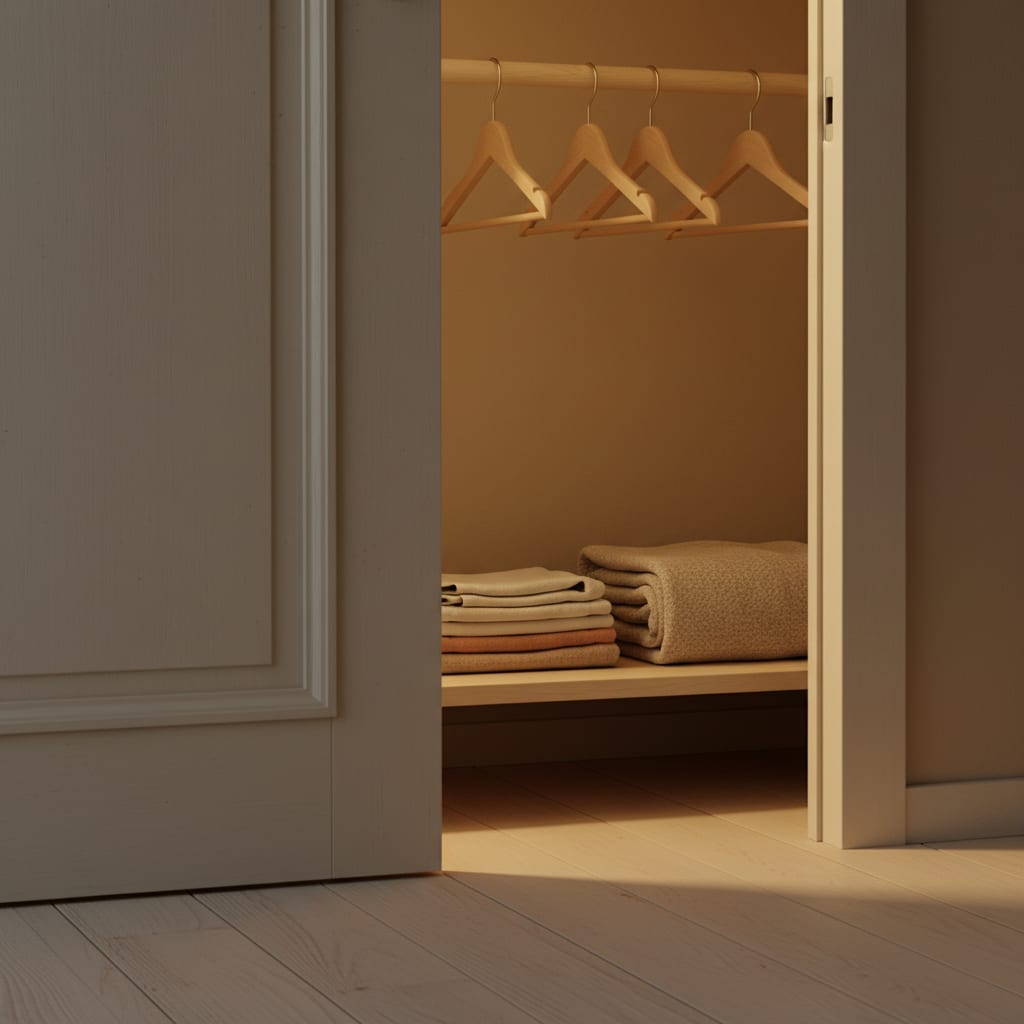
Short answer: the closet door rule is not really about the closet. A door left an inch ajar is a tall dark gap whose contents change every time a car goes past, and a child surfacing between sleep cycles has to work out what it is before they can go back down. The rule is their way of making the room identical to how they left it. So fix it mechanically rather than verbally — make the door physically latch, and take the tall, drapey, silhouette-making things out of the part of the closet the gap would show.
Which makes this, on a wardrobe blog, a genuinely on-topic problem: half the fix is hardware and half of it is what’s hanging on the rail.
What the closet door rule is actually about
Children are ruthless about sameness at night. A room that works is one that is identical at 2 a.m. to how it was at 7 p.m. — same light, same shapes, same temperature, same door positions. That’s the same mechanism behind a colour-changing nightlight waking a toddler: nothing in the room is frightening, but something in it has changed, and change is what has to be resolved before sleep resumes.
A closet door is the most change-prone object in a child’s bedroom: large, the only thing in the room that moves on its own, and leaving a gap shaped exactly right to catch passing headlights. The child who insists it’s shut has noticed something real and handled it with a rule.
A rule is only as good as the door, though. If it drifts open after lights-out the rule breaks every night, and the room stops being somewhere that stays how it was left — the same familiarity problem a freshly painted nursery causes for a fortnight.
Why the door keeps drifting open
Before you buy anything, stand in the doorway and push the closet door shut. It will do one of four things, and each has a different answer.
- It bounces back an inch. The clothes are touching the door. This is a volume problem, not a hardware problem — skip to the rail edit below.
- It closes but won’t stay. The catch is worn, missing or misaligned. Hardware fix.
- It closes and then opens when the heating comes on. Air pressure. Also a hardware fix — a catch with real tension beats a magnet here.
- It closes and rattles. It latches fine; the noise is what’s waking the child. Bumper pads.
The five-minute hardware fix
For a hinged closet door that won’t stay shut, an adjustable roller catch is the whole solution: it screws into the door edge and the frame, and you turn the roller in or out until the door takes a deliberate push to open. Deliberate is the point. You want a door a four-year-old can open on purpose and a draught can’t.
For rattle and for the last quarter-inch of gap, self-adhesive bumper pads on the frame close the door silently and stop it sitting proud. People skip them because they seem too small to matter, and a door that clacks at 11 p.m. when the house cools is a door that wakes somebody.
Bifold doors are the difficult case: they rarely latch properly and fold into a concertina of gaps. A magnetic catch at the top helps, but the two things that actually end it are a curtain hung across the whole opening on a tension rod, or taking the doors off and treating the closet as open shelving — which sounds like surrender and often works, because an open closet with nothing dramatic in it stops being a gap at all.
Thin the rail
Here’s the wardrobe half, and it’s the half that gets skipped.
A closet door that bounces open is full. Not messy — full. The rail is at capacity, the shoulders of the clothes are pressed against the inside of the door, and the door is being held open by about forty hangers’ worth of fabric. Reassurance cannot fix this. Neither can a catch, because you’d be latching a door against a spring.
The fix is the one I’d apply to my own closet, just faster: pull everything, put back only what fits the child this season, and box the rest somewhere else in the house. Then swap the hangers — bulky plastic ones are what eat the rail, and a set of slim velvet hangers recovers a surprising amount of width. Fold the knits; knits don’t want to hang anyway.
It’s the capsule method pointed at a five-year-old’s closet, and the payoff is different from the usual one: not a faster morning, but a door that shuts.
What to move out of the room entirely
Once the door closes, look at what the gap used to show — because the goal is a closet with no silhouettes in it.
Long coats, dressing gowns on the back of the door, garment bags, a tall hanging organiser, anything on a hook at head height. In flat daylight they’re clothes. Lit from the side by a streetlight at 2 a.m. they’re a standing shape, and a standing shape is the single most common thing children report being frightened of at bedtime. HealthyChildren’s guidance on frightened children says it plainly: “See if there is something that is scaring your child, like shadows. If so, make sure they are gone.”
Gone, not explained. Moving the dressing gown to a hook behind the bedroom door takes four seconds and works; explaining that it’s only a dressing gown takes twenty minutes and doesn’t. And if headlights are what turn a hanging coat into a figure, the streetlight and window fix is the other end of the same problem.
Closet Notes
Hangers: slim velvet, all matching, all facing the same way. Uniform hangers are the cheapest width you’ll ever buy back.
Height: drop the rail, or add a second low one, if the child dresses themselves. A closet that gets re-filled badly every evening is a door that stops closing by Wednesday.
The floor: keep it clear. Shoes and bags stop the door at the bottom — the failure nobody spots, because everyone is looking at the rail.
The things not worth trying
Monster spray. It confirms the premise. If the fear needs a product, the product is a door catch.
Leaving the closet light on. It turns a dark gap into a bright one and makes the outline sharper, not softer.
Negotiating at 2 a.m. Nothing agreed at 2 a.m. survives to the following night. Fix the room in daylight instead; Betteroo’s guide to the child who keeps getting back up covers the follow-through when the getting-up has become its own habit.
Assuming it’s a nightmare. A child who wakes, checks the door and settles is doing something different from a child who wakes distressed and disoriented — what’s actually happening in those wake-ups is worth reading before you treat it as fear. If the nights have gone genuinely sideways and you can’t tell which of five things is causing it, a short questionnaire beats another week of guessing.
FAQ
Why does my child want the closet door closed at night?
Because an open closet is the one thing in the room that changes after lights-out — the gap catches passing headlights and throws shapes, and the contents look different at 2 a.m. than at bedtime. Insisting it’s shut is a child’s way of keeping the room identical all night.
Should I make my child face their fear of the closet?
Not at bedtime. Remove the shape first — move the hanging coats and dressing gowns out, fix the door so it stays shut — and deal with the fear in daylight if it persists. A room that stays the same all night is what lets a child resettle without you.
How do I stop a closet door from opening on its own?
Fit an adjustable roller or ball catch so the door needs a deliberate push, add adhesive bumper pads to stop the rattle, and check whether the clothes themselves are pushing it open. A full rail will defeat any catch you fit.
What if the closet has bifold or sliding doors?
They rarely latch well. A magnetic catch at the top helps, but the reliable answer is a curtain on a tension rod across the whole opening, or removing the doors and keeping the closet tidy enough that an open front isn’t dramatic.
Keep Reading

The New-Mom Gift Guide: What She Actually Wants in 2026
Gifts new moms actually use — no novelty mugs. The Betteroo sleep app that saved us, the robe that isn't hideous, and more picks grouped by budget.
Work-From-Home Capsule Wardrobe: Zoom-Up, Comfy-Down
A work-from-home capsule wardrobe built on the camera line: 14 pieces that read polished on video, survive school pickup, and never feel like real trousers.

Ugg Tasman Dupes That Pass the Side-by-Side Test
The UGG Tasman dupes that hold up next to the real thing — the braided-collar lookalikes worth buying, the ones that flatten fast, and when to just buy UGG.